Monday, October 8, 2018

Block Island

The wind was causing the courtesy flags to flap on the shrouds, tap-tap-tap, as it lowly howled through the rigging.  Waves slapped against the hull.  The sun did not shine.  Nevertheless, we got up, got dressed, had breakfast and set off in the dinghy for land, hoping the little engine would get us there.  (It did!)  We tied up at the dinghy dock at Payne's Marina and walked about a mile into town, past lovely inns, old stone walls and shrub-scrub filled hillsides.

Old stone wall a scrub filled field
Some of the walls were originally built in the 1600's.  Although Giovanni de Verrazano came to Block Island in 1524, and the Dutch ship's captain, trader and privateer Adriaen Block charted it in 1614, it was inhabited solely by the Narrangasett Indians who called it Manisses, "Island of the Little God."  They arrived perhaps as early as 500 B.C.  They lived largely by hunting deer, catching fish and shellfish, and growing corn, beans and squash until the 1630's, when the Massachusetts Bay Colony sent 90 white men with the intention of annihilating them.  Although these men did not succeed in killing many, Massachusetts claimed the 11-square-mile island by conquest.  In 1661, it was sold to 16 families seeking religious and political freedom.  At the time, there were 1200-1500 Indians on the island; by 1774, there were 51, and the last recorded full-blooded Manisses Indian died in 1886.

The colonists built over 200 miles of stone walls and most are still standing.  When they arrived, the island was forested, but within a few decades they had cut down all the trees.  The island ecology has since reverted to the type of vegetation it had before tall trees muscled out the hardy shrubs and grasses that had existed before.  Luckily, the Nature Conservancy and the community on the island has preserved about half of the island as preserves, so it is a wonderful place to walk through the gently rolling land, past the ponds (there are over 300 freshwater ponds on this little island, some quite large), and along the bluffs and beaches.  This is what Peter and I did for about three hours earlier today.

One of the hundreds of ponds
Another pond with lilies and asters
Our route took us through the town of New Shoreham, the only town on the island.  We admired the gingerbread and Victorian houses and inns, most with mansard and gambrel roofs, widow walks and weathered scalloped siding.

Hotel in New Shoreham
House in Old Shoreham 
Modest farmhouse built in 1813
But the main attraction was unspoiled landscape.  A variety of yellow flowers, purple asters and berry laden vines adorned the fields.  The Atlantic, surprisingly calm despite the north wind, stretched to the eastern horizon from some places, while tranquil ponds surprised us around many turns in the paths and unpaved roads we traversed.

Field of flowers by a pond
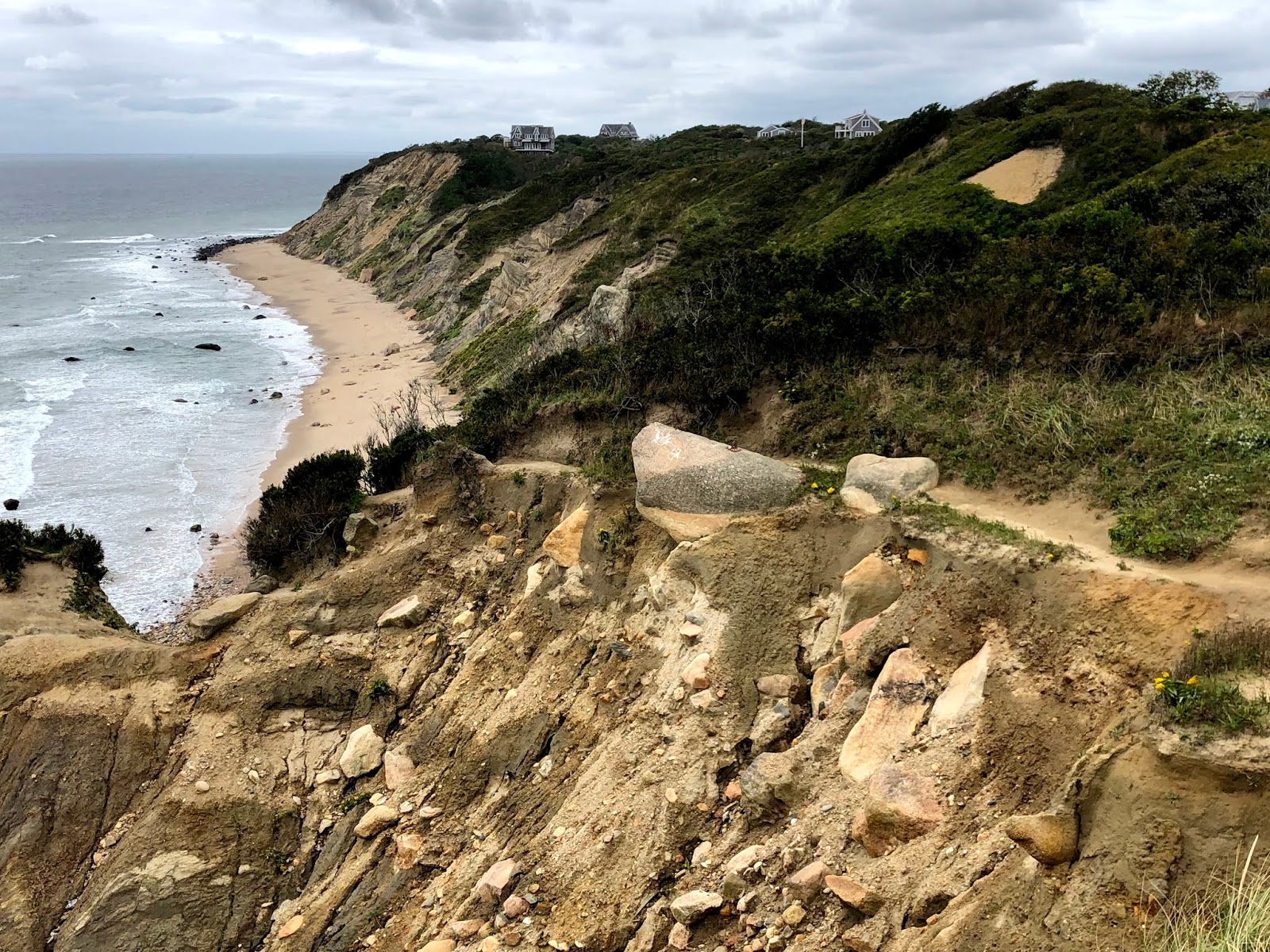
We walked to the south end of the island, to Mohegan Bluffs, were the wind and waves have eroded and shaped the cliffs into dramatic designs.  The Southeast Lighthouse was to the east on the bluffs, although not in its original location.  Erosion forced its relocation further away from the water before the land fell away below it.

Mohegan Bluffs
Southeast Lighthouse
In addition to the sweeping vistas, we enjoyed looking at shorebirds on the beaches and ducks in the ponds.  A dark, fluffy little ball of fur went scampering between my feet at one point, and it paused long enough for us to identify this cute little animal as a vole.  Peter also spotted a fluffy black, white and cream-colored caterpillar.

Ducks in a little pond
Caterpillar
After walking for a couple of hours, we returned to town, where we enjoyed lunch at Mohegan Cafe and Brewery.  Afterwards, we stopped at the only grocery store on the island to buy a few provisions before returning to the dinghy dock.  The little engine started but Peter could not push it much, so we slowly made our way across the Great Salt Pond to our anchored home away from home.

A chill has begun to set in here in New England.  We plan to make it at least as far as Boston, but we may have to head south for warmer weather after that.

Sunday, October 7, 2018

More Mystic and Now Block Island, Rhode Island

Saturday morning we were ready to leave.  We went to the dockmaster's office to get more ice, and he asked us if we wanted to stay another day.  Well, YES!  There was still so much to see and do, including the weekend Chowder Festival.  We found exhibition halls we had not had a chance to visit the previous day, including one on the history of whaling to the present day, one devoted to ships' figureheads, and one with works by the artist-in-residence Kevin Sampson.  And the demonstrations of maritime history were amazing.

Sculpture made with found pieces by Kevin Sampson
One was all about launching the whale boats from the mother ship, pursuing a whale and returning with it to the ship.  It began with a sea shanty about whaling (which I was able to sing along with) and an explanation of the process--from sighting a whale to barreling the whale oil--by one of the staff on shore.  Then, from up in a hoop high on a mast on the Charles W. Morgan came the cry of "Thar she blows!" and the excitement started.  The captain shouted out for the direction of the sighting and then ordered the tars to lower the starboard bow boat.  They scrambled, handling the lines to lower the whale boat with two men (actually a man and woman) in it.  Four others slid down these lines to join them before they released the blocks and lines which were then hauled up by sailors on deck.

Whale boat being lowered from the Charles W. Morgan
On the whale boat, the six crew got their oars in place and were ready to go, all in less than five minutes. The harpooner talked about his job and showed the crowd the types of harpoons that were used, and then the other sailors in the whaleboat explained their positions and other gear.  Nate, one of our favorite demonstrators, was the headman or captain of the whaleboat.  He talked about the types of orders he would give, how he would steer and how it would be his job--and privilege--to exchange positions with the harpooner in the bow and lance the whale in a precise location near the lungs so that the whale would drown internally in its own blood.  (Parts of the story are pretty gory!)

Nate as the headman of the whale boat
Interesting bits of information emerged during the demonstration, such as the fact that they could row about four miles an hour without a whale but only one mile per hour hauling it back to the mother ship.  They might have gone out five to ten miles after the whale, so it would take them that many hours of hard rowing to get back, often surrounded by sharks that would be biting chunks out of their cargo.  Since they got paid by the amount of blubber, they hated this!  Arriving back at the mother ship, their jobs were not done.  They had to process the whale quickly before spoilage.  They hauled the whale up alongside the whaling ship so that it hung with its tail fluke in the water and then turned it around and around to cut spiral "blankets" of blubber from the carcass.  Then, the strips were chopped into manageable sizes, cut into smaller "books," and placed in the trying pots on deck to render whale oil.  Other parts of the whale, from such as the head, were processed on deck.  Only those who were romantically naive or unable to obtain any other type of work would sign on to a whaling ship.  After the demonstration, we got to participate in hauling the 1000 pound whale boat back to its cradle.

Another demonstration was the dead horse ceremony, held on the merchant marine training vessel the Joseph Conrad.  No real horses were harmed or killed by either the Mystic Seaport staff or the sailors themselves.  Being in debt was likened to having a dead horse, and sailors who signed on for the voyage usually set sail under debt.  They were paid a month's wages in advance of departure, but they were expected to use this money for own marlinspike, knives, sheaths and other personal tools; their clothing; their foul-weather gear; their bedding; and any personal items they wanted to take on the trip.  Many spent their money on drinking and sinful entertainment while others were swindled by shysters who took their money and promised to kit them out.  These men, after boarding for sail, had to get items kept for just such circumstances from the ship's stores and go further in debt.  In any case, they all were without any cash for the first month or in debt for longer.  The sailors developed the tradition of creating a near life-size canvas horse out of worn out cloth, sewing the seams themselves and making a tail out of unravelled hemp, manila or sisal line.  They filled in with bits of metal and other debris, weighing it down so that it would sink.  At the end of the first month, they held a ceremony in which they paraded around the deck singing a shanty about the poor dead horse, abusing it as they went.  Then, the horse was hauled up onto a yard arm and as the song came to a close, it was cut loose to sink in the deep ocean as the sailors cheered.  The dead horse we used was filled with pool noodles so it would float and could be used again, but those of us (pick me!) who chose to participate rather than spectate had a lot of fun carrying him around, singing and hauling him up for his final fate.

Dead horse ready to release to the briny deep
In the afternoon, we learned about life saving services along the coast, before the U.S. Revenue Cutter Service and the U.S. Life Saving Service merged in 1915 to form the U.S. Coast Guard.  Officially, the Life Saving Service began in 1848, but even before that there were volunteer rescue crews and equipment along the coastline.  The demonstration we watched a Breeches Buoy Life Saving Drill on the Village Green at Mystic Seaport.  When a ship was identified as wrecked or in peril from the shore, the life savers would usually attempt to reach the sailors on board by boat.  In some cases, the conditions were too dangerous, so they devised a system where they fired from shore to the ship a projectile tied to the end of a heavy line .  This spooled out from a cart which they had hauled down to the shore, holding 1000 to 2000 feet of coiled rope.  For their drills, they used a high pole with a ladder up to a platform, on the other end of the green from the cart.  Two men pulled the line, simulating its flight to the ship and then carried it up with them to the platform where they secured it and waited for rescue.  Meanwhile, those on shore hustled to get all the lines anchored to the ground and taut on their end.  The goal was to get to this stage within five minutes from the time they started setting up.  Then, a life buoy attached to a pulley with cut-off pants sewn in was pulled out along the line from ship to shore, and one by one, sailors would jump in and be hauled to safety.  The addition of the breeches was a 19th century innovation to deal with the fact that many men, particularly those who were injured, were unable to hold themselves on to the life buoy with their arms and slipped through (to their deaths).  In the past, volunteers would practice this two or three times a week throughout the year.  We were amazed to learn that either through rescue by boats or this method, the U.S. Life Saving Service had over a 95 percent success rate.

In addition to these three demonstrations, we listened to a staff member explain the use of instruments for determining latitude dating back over 3000 years while he showed us astrolabes, octets, sextants and other instruments and highlighted the men and cultures who developed them.  We were educated and entertained by a woman in period dress who was role-playing as the owner of a boarding house for shipyard workers in Mystic in the mid-1800's.  We stopped in the drug store, the doctor's office, homes, the Mystic Bank and other buildings.  For a break, we bought lunch from the vendors at the Chowder Festival and listened to a solo performer singing and playing songs from our teens, 20's and 30's and ballads.

Mystic Bank
Instruments and medicines in the doctor's office
Patented medicines
Late in the afternoon, we walked into town, admiring the many preserved 19th century homes of shipyard owners, carpenters, merchants and other members of the community of Mystic, now worth a fortune, we assume, and inhabited by local families.

Home of Thomas Greenman, shipyard owner (with his two brothers, who had houses beside this one)
Home of Charles Greenman
We watched as the bascule bridge closed to vehicular and foot traffic and then opened to let the steamboat Sabino from Mystic Seaport through.  We looked in a few shops and the wonderful independent bookstore before finding an outdoor restaurant called Treetops, where we ate delicious and unusually prepared vegetarian food for dinner before returning to Mantra.   Since the laundry was available, I did one last load that evening.

Mystic Bascule Bridge
We had a couple of more hours to wander around this morning at the museum.  First, we visited an exhibition about the Vinland Map, the unveiling of which was announced to the public on Columbus Day in 1965 by Yale University, claiming it was definite proof that the Vikings had "discovered" America before this Italian explorer.  Although the subject was widely debated and analyzed, the general concensus within ten years was that it was a forgery.  Nevertheless, the archeological excavations and discoveries along the coast of eastern Canada offer compelling evidence for Viking exploration and habitation at the end of the first millennium, hundred of years before other Europeans.

Our long visit was finally over, and what I have written about is only a small portion of what we saw, experienced and learned at this wonderful museum.  It has been the highlight of our trip this fall so far.

We washed down the decks and got ready to cast off, which we did at 11:30 this morning, in time to reach the bascule bridge in time for the 11:40 opening.  Zigzagging our way out of Mystic Harbor, we  then set sail for Block Island, Rhode Island.  The winds were favorable and we were able to sail all the way to the entrance to Great Salt Pond, a large protected harbor on the northern side of the island.

One of the four lighthouses on Block Island
After Peter's cup of tea, we put the dinghy in the water and Peter mounted the smaller of our two outboard engines to the stern.  He decided to take it for a test run, which proved to him that the float was staying open, requiring him to fix it before we could take off.  For him this was slightly frustrating but also enjoyably challenging.  When he removed the cover and started taking it apart, he realized that previously someone had taken it apart and put it back together without one of the parts.  Of course, the part was not around anymore, but, genius that he is, he was able to create a substitute.  Now, two hours later, he believes it is properly repaired.

In is nearly 8 p.m. and dark. Since we don't know the shoreline or where the dinghies dock are, we will wait until the morning to explore on shore.  Now I must make us some dinner.

Friday, October 5, 2018

Mystic, Connecticut

Yesterday morning, we raised the anchor in Westbrook and sailed a few miles east to the lovely town of Mystic, Connecticut, on the tranquil Mystic River.  We entered the harbor and followed the marks weaving around the mooring fields.  Heading up the tidal river, we watched the railroad swing bridge pivot and then passed through, after which we waited for the 40-minute-after-the-hour opening of the Main Street bascule bridge, and motored a short distance to dock at the Mystic Seaport Museum.  Dockage for two nights included admission to this fabulous living history museums in the country, with exhibits, restored ships, a shipyard, and a seaport village comprised of buildings saved and moved here from various parts of New England.  We arrived in the mid-afternoon, so we only had a couple of hours to spend looking around yesterday before the grounds closed (with us inside!) at 6 p.m.

The marina has showers (although the one on Mantra is really quite nice and I chose to use it rather than the marina ones so I didn't have to carry toiletries and a change of clothes to the building).  It also has a laundry, which the dockmaster had cautioned us against using because the machines do not always function properly, but with piles of dirty clothes and sheets and towels that hadn't been laundered in a few weeks, we gave it a shot.  The washer and dryer worked wonderfully, although Peter had to find a small lever to move in the mechanism for coins on the dryer to get it to work, and I did two loads last night and two loads this evening.  Everything is clean!  We have shore power and were able to fill up the tanks with water, so we are set to go.

Yesterday evening, we walked the short distance into downtown and had dinner at Anthony J's Bistro, which had a cozy, quiet atmosphere and great food.  Peter tried something new:  thresher shark!  He said it was really good.  We finished the meal with scrumptous pumpkin cheesecake, and then walked around the downtown area looking in shop windows of galleries, boutiques, jewelry stores and a large independent bookstore.  On the way back to the Seaport, we walked down a different street, passing many large and lovely homes on big lots, all built in the 19th century for ship captains, financiers, shipbuilders and others who became modestly wealthy on businesses associated with commercial fishing, particularly whaling.

The buildings and exhibits of the museum opened at 9 a.m. this morning, and I had to leave Peter alone to finish his breakfast because I didn't want to miss a thing.  (Our stroll through the grounds yesterday had shown us that there is a lot to see.)  I had a schedule of the weekday activities and had highlighted all the ones I wanted to attend throughout the day.  The demonstrations and activities encompassed lobstering, oystering, cod-fishing, fish-splitting, cooperage, women inventors, rope-making, sail-making, working aloft on a square rigger, mast hoop construction and leisure time activities on long voyages.  Between demonstrations, we visited many of the buildings, including the cooperage, the blacksmith shop, the Mystic Print Shop, the hoop shop, the nautical instruments shop, the chandlery, the sail loft, the rigging shop, the cordage factory, the small boat exhibit, the lobster house, the oyster house, the salmon house, the clam shack, the life saving station, the store, the chapel and a building housing a scale model of Mystic River in the mid-1800's.  There are also many historic ships to board, including the 1908 coal-fired steamship Sabino; the L.A. Dunton, a cod-fishing ship built in 1921; the Charles W. Morgan, built in 1841, the last remaining wooden whaling ship in the world; and the Joseph Conrad, a training ship built in 1882 that was used to train thousands of cadets.  The history of each of these ships as well as about a dozen more on the waterfront is rich with the stories of their construction, the people who sailed on them and the voyages they made.

Throughout the day, we were educated and entertained by three staff members who conducted the various activities.  They had a depth of knowledge about everything from sail making and rigging to whaling, oystering, clamming, lobstering and fishing.  In addition, they demonstrated expertise and skill in various areas including coopering, rope making, engine maintenance and fish preparation.  There didn't seem to be any question they couldn't answer.

We stopped briefly for lunch at one of the restaurants on site and continued to absorb as much as we could about the myriad of activities, boats and shops represented here at Mystic Seaport until the buildings closed at 5 p.m.

The laundry is in the shipyard, so I walked around there while waiting to move loads.  The shipyard is in the process of restoring the Mayflower II, a 1957 reproduction of the original Mayflower.  It is much bigger than I expected, particularly in the depth of the keel.  It is all under cover and surrounded by scaffolding, so it is not possible to get a good view of the entire ship, but the size of the timbers being used is impressive.

We have two hours tomorrow morning before we have to leave the dock at 11:30.  There is a chowder festival this weekend, so we may get to experience some of that before we depart.

I took lots of photos.  Here are some of the best (not in terms of photography but in terms of showing what it is like here).

View from Mystic Seaport
Bow of the Mayflower II
Sail Loft
Rope making demonstration
Blacksmith tools
Cooperage
Rigging on the Charles W. Morgan
Nate unfurling a sail on the Charles W. Morgan
Bobbins of thread, 48 on each side, for feeding into the rope-making machine in the cordage shop
Threads from the bobbins going through the thimble plate at the beginning of the cordage process
Ships' lights in the chandlery
Traditional lobster traps
Salted cod on a fish flake rack
Mary getting ready to split a cod
The Charles W. Morgan
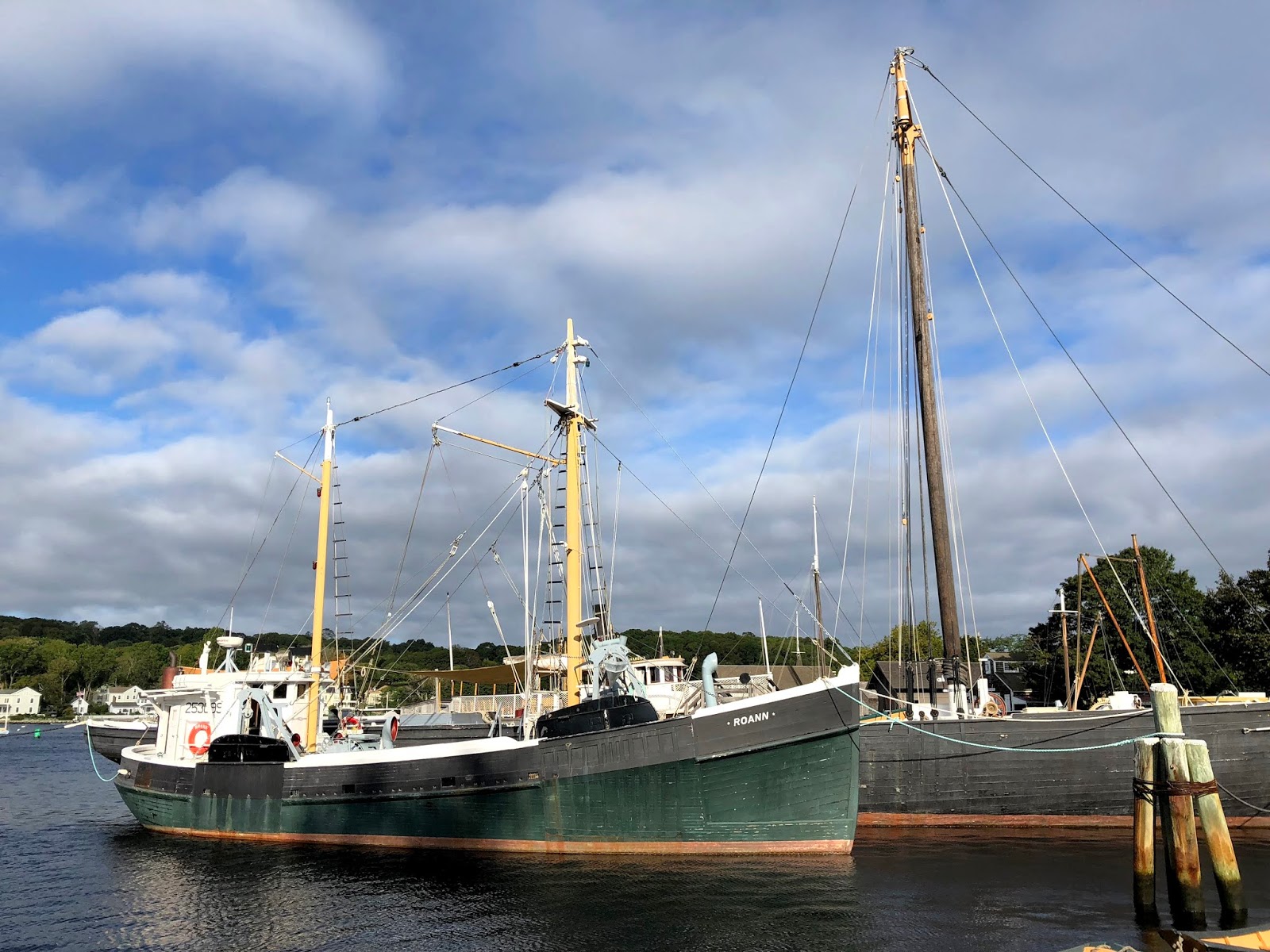
Two cod fishing vessels
1908 Coal-Fired Steamboat
A Danish Light and Buoy Boat that saved hundreds of Jews by sneaking them to Sweden in 1943

Wednesday, October 3, 2018

Duck Island Roads near Westbrook, Connecticut

Last night the thunderstorm produced flashes of light emanating from behind the clouds like Morse Code, and the thunder rolled and rumbled.  I had to sit in the pilot house for a while before bed enjoying it.  From the west to the east, arcing across the northern horizon, each burst of light silhouetted the low-lying hills of Long Island Sound black against a ghostly blue background.  It was a light and sound show, but unlike man-made ones, the range of color was small and the only part of the orchestra that showed up was the percussion section.  Nevertheless, or maybe because of this, the experience was wonderful.  The atmosphere was literally electric.  Even though I understand how the rain, lighting and thunder are produced, I still find these displays powerful and magical.

When I went to bed and closed my eyes, I felt like I was going up and down on a gentle carousel horse as the merry-go-round went round and round.  This feeling was induced by the lapping waves against the hull and the swaying of the boat as the storm winds shifted subtly, two separate motions.  It was quite enjoyable, and it rocked me to sleep.

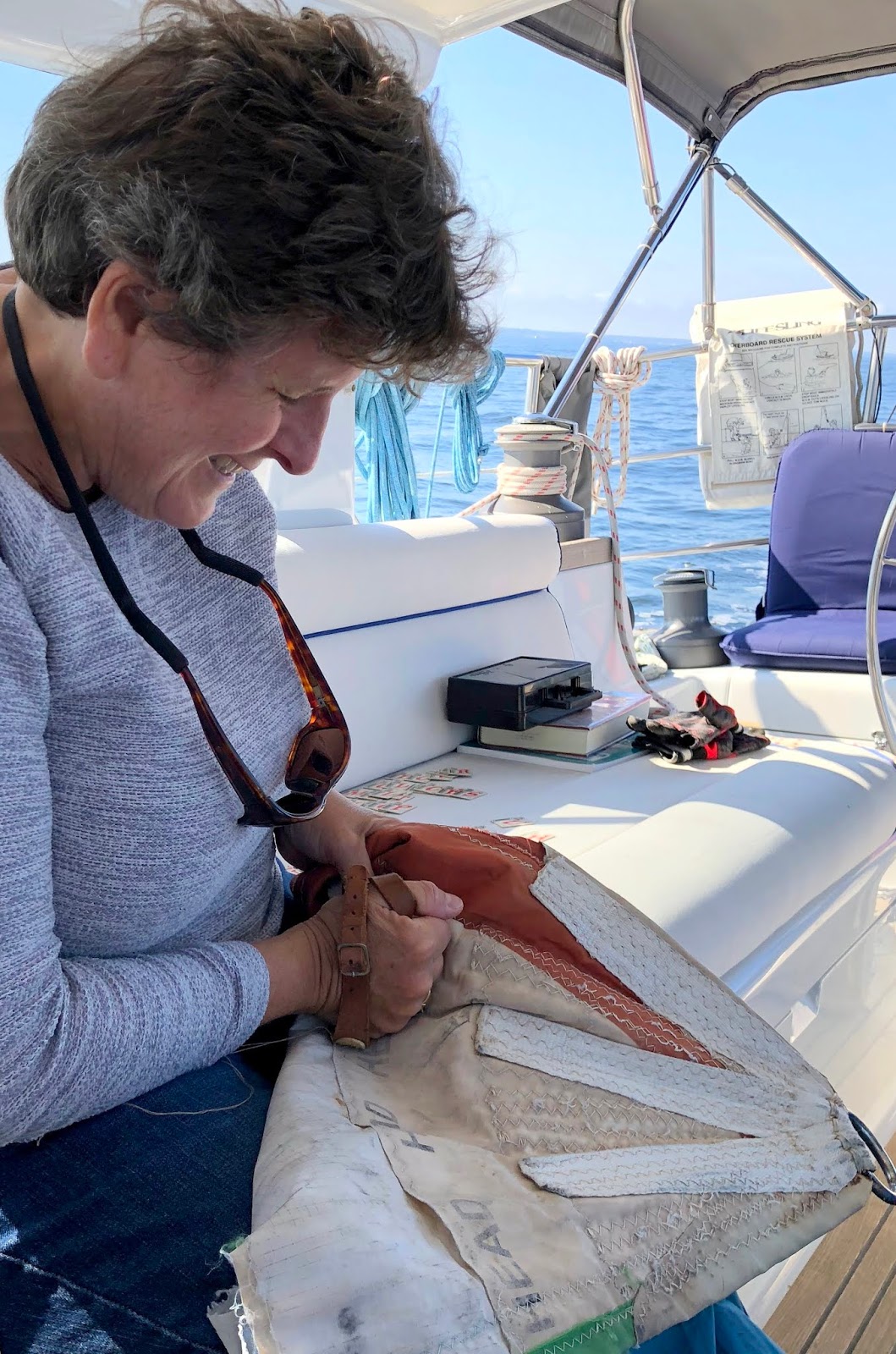
This morning we arose before sunrise, and we started pulling up anchor as the sun popped up on the eastern horizon in a clear sky.  We traveled east for 12 hours, anchoring at Duck Island Roads near Westbrook, Connecticut, after most of the light had left the sky.  Although the wind was coming from the north and we could sail on a beam reach, it never picked up above 5 or 6 knots.  So, we only got in about four hours of actual sailing at a leisurely pace.  It was a pleasant day, though.  After we got under way, I sewed the tears on the spinnaker caused by our accident a couple of weeks ago.  A couple of days ago, Peter created a connecting piece of spliced line, replacing a rusted steel cable with Spectra polyethylene line to attach the spinnaker sock to the head of the sail, so it was ready to be raised and unsocked to utilize as much of the light breeze as possible.

Sherri sewing the spinnaker
The spinnaker flies again!
Living aboard a boat is in many ways not much different from living on shore.  It affords us the opportunity to travel with most of the amenities of home, but it is rather isolating.  Luckily, Peter and I enjoy each other's company 99% of the time!  I do miss my friends and my students, but I manage to amuse myself most of the time reading, studying Spanish and playing games like Anagram (often by myself because Peter is always busy puttering, although we played two games of checkers today).  Cruising is a rather self-indulgent life-style.  And it makes me appreciate even more all the wonderful things at home in California--our lovely and comfortable house and garden; our great friends and neighbors; the library and the club; tennis, bicycling and other activities; and so many conveniences--not to mention ice cubes!

The sun does set on the British Empire

Tuesday, October 2, 2018

Vanderbilt Museum and Planetarium

Eagle's Nest from Mantra
In the late morning, after I took a shower on the swim deck and we had breakfast, we were ready to set off for Northport to visit the Vanderbilt Museum, including the summer home of Eagle's Nest and the planetarium.  The adventure began immediately.  I got into the dinghy while Peter was still in the cockpit locking up, believing the dinghy's painter to be secured on a cleat on deck.  Nope!  It let loose and I was adrift with the sudden realization that I really didn't know how to use the outboard motor!   Shouting from the swim deck as I slowly slipped further away, Peter guided me in getting the engine in the water, using the choke, pulling the cord and getting the engine started.  He was almost out of range for my hearing him, and I didn't know where the gearshift was!  He was wondering if he was going to have to swim to me.  With various hand signals from him and my own wits, I was able to find it and realize that forward would mean pulling the handle forward (Duh!).  After making a couple of tight turns in the water, I figured out how to maneuver the dinghy and made it back to Mantra.  It is unfortunate that there was no one around to video this hilarious incident.  It would have been a hit on YouTube.

In my defense, it has been over ten years since we owned a boat, and in the three years we had Epicurus, I rarely drove the dinghy.  If Peter wasn't driving it, then Matthew was.  It was his favorite thing to do when we were living on board.  Realizing that I might need to hone my skills, I drove it to the dock this morning and back to Mantra late this afternoon.

In town, we got a Lyft.  The driver was a 40-year-old Pakistani-American Muslim woman, separated from her husband and, therefore, living with her parents (as is her 30-year-old brother, since he is not married).  She kept us entertain telling us stories about her family and cultural customs as she drove us out of town and up the hill to the Vanderbilt Museum.

Mantra (fartherest large sailboat toward the right) from the Vanderbilt estate
The mansion, called Eagle's Nest, was built as a summer cottage on 43-acres in Centerport, on the Gold Coast of northern Long Island, by William Kissim Vanderbilt II (1878-1944), the great-grandson of the railroad magnate Cornelius Vanderbilt.  Born into a life of extreme wealth and luxury, he grew up in various Vanderbilt mansions, traveled to Europe frequently with his family, sailed the globe on yachts owned by his father and was privately tutored before prep school and Harvard.  While he worked at times for his family's New York Central Railroad at Grand Central Station in the city, he devoted himself to his various interests and hobbies, including horse racing, car racing, yachting, and collecting.

When he was 20 years old, Vanderbilt, known to family and friends as Willie K., met Virginia Graham Fair, know as Birdie.  She was several years older than he and had been born in poverty in San Francisco.  By the time they met, however, she was a wealthgy young lady.  She had inherited part of the substantial fortune of her father, and Irish immigant named James "Slippery Jim" Fair, one of the four "Silver Kings" of the rich Comstock Lode in Nevada.  (She and her sister built the Fairmont Hotel on Nob Hill in San Francisco.)  Willie K. and Birdie were married in 1899 and had three children, one son and two daughters.  They divorced in 1927 after years of separation and he immediately remarried.  His second wife was Rosamund Warburton, and she sailed with him often, including on two circumnavigations.

Vanderbilt was recognized as an accomplished sailor, yachtsman and race car driver.  In 1900, he won the Lipton Cup trophy (an enormous and ornate silver cup on display in the museum) with his 70-foot yacht Virginia.  In 1904, he sponsored the first Vanderbilt Cup Race for motor cars on Long Island.  In the first half of the twentieth century, it was the second most popular sporting event in America, after the Kentucky Derby.  It used public roads until the local authorities objected because of two many accidents and deaths of spectators.  Vanderbilt, along with other investors, created the Long Island Motor Parkway to be used for the race once a year and at other times as a tollroad.  It was one of the country's first modern paved turnpikes.

In 1933, his son, William Kissam Vanderbilt III, died in an accident while driving home from their estate on Fisher Island in Florida.  He would have inherited the mansion as well as other assets.  After his death, Willie K. built a memorial wing onto the house to display memorabilia, trophies and souvenirs including those from his son's African safaris.  He then opened the estate for public viewing several days a week and re-wrote his will so that, upon his death, the Eagle's Nest property and a fund for upkeep could become a public museum.

The house itself was constructed in three phases.  The first part was designed as a 24-room Spanish Revival palace and built in 1910.  We took a tour of the house first and learned a lot about the family and their lifestyle when they lived here.  By their standards, this home was not lavish and it was not intended to host large parties.  However, the rooms are elegant and beautifully furnished, and the courtyards, gardens and views are lovely and tranquil.  (And the King of Enland at the time did visit.)    Using the same architectural style, the second part was added in the 1920's, after Willie K. inherited some of his father's wealth ($21 million) upon his death and married his second wife.  The memorial wing was completed in the 1930's.

Peter in the rose garden at Eagle's Nest
Portcullis and entrance to Eagle's Nest
Library
Small enclosed courtyard
Courtyard outside the Memorial Wing
In addition to the family's living quarters, Willie K. also included exhibition spaces for his various collections in his home.  He added the Habitat Wing in the 1920's, and, along with scientists and artists from the Museum of Natural History in New York, created nine remarkable dioramas of animal life.  Hanging from the ceiling is the world's largest taxidermed fish, a 32-foot whale shark caught accidentally by fishermen off Fire Island in 1935.  An additional area includes specimens of large animals such as a polar bear, lion, tiger, jaguar and leopard collected and donated by Charles Stoll, a local judge who was a explorer, naturalist and big-game hunter.

Most of the specimens were collected by Vanderbilt.  His traveled to the Galapagos Islands, throughout the Pacific, Asia, the Mediterranean, Africa, the Atlantic and the Caribbean, and his voyages yielded thousands of specimens of marine, bird and insect life, some of them new discoveries when he found them.  In the Memorial Wing are rooms full of these specimens.  The room with preserved marine life and shells from all parts of the world is stunning in its diversity and symmetry.  Another room includes butterflies and moths, birds from far-flung as well as local places and an assortment of ethnographic artifacts collected in the South Pacific, Indonesian, Australia and New Zealand still displayed as they were in the early half of the 20th century, so that it is like a musuem of a museum.  Tools, jewelry, weapons, baskets and other items are mounted on precious tapas and woven mats from tribal cultures.  Numbers corresponding to the guidebook entries are stuck right on the artifacts!  Museum curators today would never do such things, but it has a warm and intimate feel.

Room with marine specimens and a model of the Alva, one of the yachts in which he circumnavigated
display of ethnographic artifacts from the South Pacific
Peter and I also went to the planetarium show at 2:00 (after the mansion tour and before seeing the exhibit spaces).  The planetarium was added by Suffolk County, which owns the property, in 1971.  I don't think I have been to a planetarium show since the kids were little. The night sky as it would appear tonight was shown and discussed as were a few constellations.  I will never be able to understand how ancient people in various cultures saw people and animals in these collections of stars.  A special feature at the end was a trip to the edges of the universe as if we were on a spaceship.  This was new and fascinating for me, and it made me wonder about communication across the vast expanses of space.  One of the staff was quite willing to answer my questions with answers including information about radio waves, the speed of light and red shift.  Outside, Peter and I discussed the possibility of communication faster the speed of light, perhaps by quantum entanglement.  Science is fascinating!

We had assumed that we would spend two or three hours at the Vanderbilt Museum, but they had to ask us to leave at 5:00 (although the docent let us, no, encouraged us, to peek into one more room before we left).  Outside, thunder was rumbling in the distance, but our Lyft ride arrived just as the first few drops of rain fell, and the brief shower was over before we got back to town.  We stopped at the Copenhagen Bakery for scones for afternoon tea (or Diet Coke in my case) on the boat and we also bought a quiche to have for dinner.  Expecting rain and planning to travel most of the day tomorrow, we hauled up the outboard motor and the dinghy before settling down for our treats from the bakery.

Heavy rain arrived after we were cocooned in the salon down below.  The wind is about 15 knots, and lightening is flashing behind the clouds as thunder booms, but we are safe inside.  We are also dry, but that is only because we avoid the places where the hatches leak in heavy rains!  We are always ready with old towels and a basin to catch the biggest drip.  Eventually, we will get the problem fixed.

Meanwhile, I am enjoying the storm and thinking of my mom, who always liked to sit on the front porch to watch brilliant ones like this.


Monday, October 1, 2018

Northport Harbor, Long Island

Yesterday (Sunday, the last day of September) was a very, very dull day.  A respite in the tedium was given by two visitors from a boat anchored nearby.  Susan and Mark have lived on their boats for 42(!) years but mostly stay at their berth across the sound in Connecticut or tour New England.  They admired our boat.  During conversation, we learned that Mark had worked for years constructing boat hatches and windows, and he provided Peter with a wealth of information and tips in just a short period of time (while Susan and I talked about where we had visited and family).

After they left, we got the dinghy motor on board, tidied up and pulled up anchor in order to travel just a few miles to Northport Harbor to the east.  We motored out into the sound and then attempted to sail, but 6 knots of wind quickly became 3-4 knots, and with a boat speed of 1 knot we had no steerage, so we had to go back to the engine (which, fortunately, is very quiet, although not as tranquil as sailing).

Two hours later, we had dropped anchor behind hundreds of moored boats.  Long Island's Gold Coast "summer cottages" (i.e., mansions with manicured lawns, beaches and boathouses and other outbuildings) lined the shore or hid among the verdant foliage of the woods.  (There is no fall color yet.)  After the sun dropped behind the western hills fairly undramatically, the sky blushed shades of magenta, rose and gold as darkness fell.
Sunset, Oyster Bay
Today, Peter got the smaller outboard engine out of the forepeak, sure that he was going to love it compared to the heavier one we have been using.  (Yes, there are at least two of many things on this boat!)  Unfortunately, the carburator seems to be fouled, so we had to haul out the heavier one and use it until Peter or someone else can repair the little one.

We dinghied into the town dock.  We have found that Long Island Sound does not really seem to cater to blue water cruising vessels at anchor and their dinghies.  There have not been any free, public dinghy docks in the towns we have visited with the exception of Oyster Bay (although there was only room for a couple of dinghies).  We had to pay $10 in Cold Spring Harbor, and in Northport, there is not even one available for a fee.  No one seems to anchor.  The bays and harbors are full of rows of mooring balls, and the marinas or yacht clubs that maintain them offer launch service.  I was not sure what this meant when I read about it being available in some of the listings in our guide book, but now I realize that the people on the moored boats do not use dinghies but rely on the marina or club to take them to and from their vessels in a small open motor boat.  I suppose this is very civilized, but I like the freedom of having a dinghy for exploration.  I had also heard that it was common for boats to raft up in Long Island Sound and New England, particularly when it is crowded.  We saw three boats do this in Oyster Bay on Sunday for a while, apparently just to socialize for the afternoon.  So, the boating culture here is a bit different than what we have been used to in the Caribbean; it is more about day sailing and racing.

In the town of Northport, we learned a little bit about its history (a main goal for me everyplace I visit) and had an excellent lunch on the patio at Tim's Shipwreck Diner.  After our meal, we were offered (and accepted!) complimentary pumpkin pie, which was a delicious treat.  Afterwards, we bought milk at a small organic foods store. (There are no groceries or convenience stores within walking distance of the town dock, where we left our dinghy when a couple local men on a docked boat offered to keep an eye on it.)  Then we bought ice for our still non-functioning refrigerator (although the unit has been shipped from California today!!!!) and enjoyed chatting with the proprietors of the small delicatessen where we found it.  Importantly, we picked up four cans of Diet Coke, which should keep me happy for a couple of days.

About the history of this town:  Originally the home of the Matinecocks, the area of Northport was first seen by a white man scouting from New Amsterdam in 1650.  He reported "good fishing, fine meadowlands and mostly level ground suitable for farms and cattle."  Five years later, three Englishmen purchased the land for seven quarts of liquor, two coats, four shirts and eleven ounces of powder.  The small colony flourished with an economic base in agriculture and shell fishing.  Some of the existing homes date back to the 18th century and many of the brick edifices lining the business section of Main Street are from the 19th century and are now occupied by small restaurants and cafes, galleries, boutiques as well as a small drug store and a hardware store that probably has a good inventory but has the look of the one in the town in which I grew up a half century ago.

Main Street in Northport, Long Island
Peter is now working to repair the spinnaker with various tools, large and small (including an enormous pair of wire cutters).  The array of tools that are on this boat is one of the things he loves about it.

Peter and Fun with Tools
Tomorrow we visit the Vanderbilt Museum, one of the former homes of a great-grandson of Cornelius Vanderbilt, who made the family fortune.  The next day we sail further east in the sound, but predicted light winds may require the spinnaker to get enough speed.