Thursday, October 18, 2018

Plymouth, Part 2

This morning, as we were tossing around in the winds and waves of our anchorage between the channel to the harbor and Plymouth Beach, I glanced out one of the ports and saw the harbormaster's boat coming up beside us.  The two people on board were quite concerned that we would be on the bottom at low tide and suggested we come in behind the breakwater; they had a mooring ball for us.  I guess we should have radioed them yesterday when we anchored; we probably could have had a more peaceful night.

We had omelettes and Mexican rice for breakfast and got ready to pull up anchor, which wass not as straightforward as usual with the winds over 20 knots and a current.  What was more tricky was picking up the mooring line on the giant, rusted mooring ball.  The harbormaster was supposed to be there to assist us, but he was just speeding away from his dock as we entered the protected part of the harbor, en route to rescue a boat with a dead engine.  We circled around it several times, but several lines were hanging from it, and we were not at all sure which one to grab with the boat hook.  Luckily, the harbormaster came back, dropped off the boat he was towing at a dock and came to our rescue.  I was able to pick up the line, but it was a challenge getting it secured on deck.  Luckily, the female harbormaster jumped on board our vessel and helped me out.  (Actually, I just got out of her way as she had things well under control.)

Mantra on a large rusted metal mooring ball off the Town Wharf
The inner harbor is much calmer, and we were practically within spitting distance of the dinghy dock.  (And there was no charge for the mooring ball!)  After a hot beverage, we got the dinghy ready and quickly made it to land.  Unlike the Pilgrims, we did not head for a rock but to a floating dock.

We had lunch at Wood's Seafood right on the wharf.  Like many places on the east coast of the U.S., particularly seafood establishments, there are no vegetarian options at all on the menu, so I had onion rings for lunch while Peter thoroughly enjoyed his lobster bisque and fresh-caught halibut.

After lunch, we walked across the street to the Visitors' Center where we obtained a walking tour map from the friendly docent.  We walked for hours this afternoon, exploring this prosperous little town that started out as a little village of huts with thatched roofs in 1621.  (Although they arrived here in November of 1620, the passengers of the Mayflower lived on the boat until they were able to establish themselves on land in the early spring.)  Of course, none of the original houses is left, but we did come across the marker for the plot of land that was alloted to Peter Brown!  There are structures dating from the 17th century, just none that were the original homes of the Pilgrims.

Peter by his lot
Normally, visitors could tour the Mayflower II here, but not now.  Fortunately for us, we saw it where it is being restored in Mystic, Connecticut.  The first highlight of our walking tour (narrated by me but punctuated with bronze plaques in stones or on walls throughout the area) was the dubiously famous Plymouth Rock.  It's a rock.  In recent history, it has been inscribed with "1620," but otherwise it is unremarkable.  It may not even be in the place where it was originally because it was moved a couple of times to protect and venerate it before being returned to the shore.

Plymouth Rock
Above and inland from the rock is Coles Hill, purportedly the secret burial place for the people who died during the first year.   Supposedly, they planted crops to conceal the graves.  The immigrants did not want the natives to realize the dire situation they were in.

Also on the hill, facing the harbor, is a large statue of Massasoit, the leader of the Wampanoag tribe who befriended the colonists.  Right beside it is a plaque recognizing the gathering of the United American Indians of New England that takes place every year on Coles Hill on Thanksgiving during which the history of this area since the early 1600's, as told in their cultural stories, is remembered.  From their perspective, it is a history of "genocide, theft of lands, and never ending repression."

Statue of Massasoit
From this sobering site, we walked up Leyden Street, which was originally called First Street, where the first houses erected by the Pilgrims stood.  Although the houses are gone, there are plaques recognizing the sites, and many of the current buildings date from the 1700's.  We walked back down the hill to Brewster Gardens, through which runs Town Brook.  This stream is fed by numerous springs and was undoubtedly one of the reasons the Pilgrims chose this site for their settlement.  In the 18th and 19th centuries, dams and mills were built along its course for supplying power to the growing industries.  In the park is the Pilgrim Maiden Statue, dedicated to "those intrepid English women whose courage, fortitude and devotion brought a new nation into being."

Pilgrim Maiden
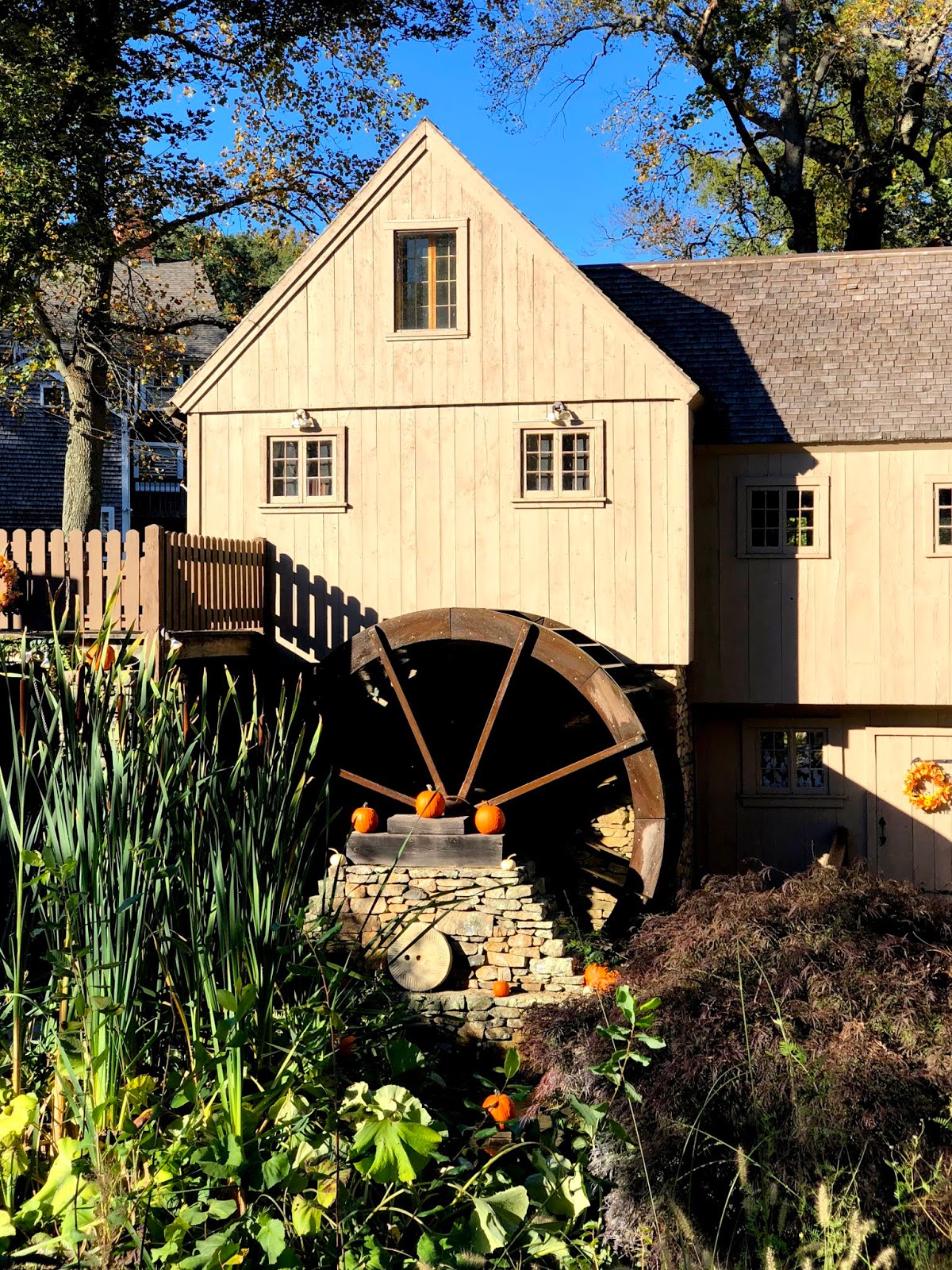
We walked inland through the park until we came to Jenney's Grist Mill, a reconstruction of the original grist mill that John and Sarah Jenney built on the site in 1636.  We also visited the Richard Sparrow House, built in 1640, Plymouth's oldest restored house.  Sparrow came to Plymouth in the decade after the Mayflower colonists.

Jenney Grist Mill
Interior, Sparrow House
Surrounding the original small town square at the head of Leyden Street are a wooden court house and two impressive churches.   The town square, although smaller than a city block, was the focal point for civic, religious and commercial affairs form 1621 to after WWII.  The pilgrims built a fort and meetinghouse on the hill overlooking the square, and the public market was held here on Thursday beginning in 1639.

The First Parish Church (built in 1899) now facing the square is the sixth meetinghouse of the congregation brought to America by the Pilgrims, and it is the oldest continually active congregation in the country, according to the Anglo-centric view of U.S. history.  Conveniently forgotten (and not taught to me in public schools) is the fact that the Spanish established Roman Catholic congregations which have continuously held services in San Juan, Puerto Rico (1521), in St. Augustine, Florida (1565), and at San Juan Bausista in New Mexico (1598).  In addition, English settlers in Virginia established the still functioning St. John's Episcopal Church in Hampton, Virginia, in 1610.

First Parish Church
Also facing the square is the lovely white wooden meetinghouse, the Church of the Pilgrimage.  This congregation was established in 1840 after the congregation of the First Parish Church moved to Unitarianism.

Church of the Pilgrimage
We climbed the steps beside the First Parish Church up to Burial Hill, the site of the Pilgrim's first fort and meetinghouse.  The cemetery has old stones from the 17th-19th centuries; the last burial here was in the mid-20th century.  The earliest tombstones were made of wood, but most were later replaced with stone.  A small obelisk marks the final resting place of the body of William Bradford, the first governor of the Plymouth Colony.

William Bradford's stone 
Burial Hill with a view of the harbor
In addition to the many historic sites, we also encountered many lobster statues in front of various buildings.  Here are a photos of a few of them.

Lobsterman Lobster
Woman in Gold Lobster
"Claws" Monet
Peter walking by another lobster on the waterfront, with Mantra on the giant mooring ball
It was after 5 p.m. when we returned to Mantra.  We went back into town and walked to the nearby East Bay Grille for an excellent dinner in a nicely warm and pleasant environment.  Since returning for the night, we have run the space heater for about half an hour.  The temperature difference is negligible.  My fingers are quite cold, so I am ending here to join Peter in the bed, which I hope he has warmed up for me.


Wednesday, October 17, 2018

Plymouth, Massachusetts

First of all, let me just say that I am very tired of wearing layers.  If we weren't planning on attending the Head of the Charles in Boston this weekend, we would have turned south days ago.

The anchorage last night was sweet.  After showers and breakfast, we pulled up anchor before 10 a.m., motored out of Onset Bay to the western end of the Cape Cod Canal and went with the flow through that.  Unfortunately, sailing is not allowed in the canal, because the weather was perfect to set sails (if you ignored the cold!)  We had nearly 20 knots of wind from the west.  After leaving the canal, we set the main with two reefs and the jib on a port tack at a beam reach.  Even with the reefs, we were heeling over a bit, particularly when the wind gusted to 25 knots.  When we arrived at the entrance to the meandering channel into Plymouth Harbor, we doused the jib and followed the red nuns and green cans.  The anchorage to the east of the channel is narrow and not very deep, but we found a good spot on the second try.

Plymouth Lighthouse
The wind picked up after we had lunch, with gusts up to 40 knots for a while.  I was resting (actually, trying to get warm) under the covers and it felt like I was in a washing machine, and not on the gentle cycle.  We ran the space heater for about a half hour before dinner, so now the temperature in the boat is maybe around 60 degrees.

Peter prefers to anchor rather than dock when the wind is strong and gusting, but I think that we will need to tie up in town tomorrow for the day and night despite the predictions that the wind will not abate.  The weather forecast also is predicting a high of 46 degrees tomorrow afternoon.  The combination of low temperature, chilling wind and slapping waves is enough to deter me from using the dinghy to get to town.  In addition, with shore power, we can run the space heater as much as we want.

My brother Terry has forewarned me that Plymouth Rock is not much to look at, but it is right on the shore in town, so we will take a peek.  I just don't understand the hype (despite reading the sketchy history of how it came to be revered).  When I was growing up, in school we learned (and the story was repeated every year at Thanksgiving, so it was hammered in) that the Pilgrims landed at Plymouth Rock, and there were even illustrations to show the momentous occasion.  I swallowed it hook, line and sinker.  (I was such as conpliant student!)  Growing up in West Virginia in the foothills of the Appalachian Mountains, I only saw the coast in the summer during vacations to rock-free, sandy shores.  I think I imagined that the rock, in addition to being sacred to Americans, was a unique feature.  There are so many fallacies here.  First of all, the coast of New England is littered with rocks varying in size from pebbles to promotories and monoliths, relics of the moraines and erratics deposited by glaciers.  Sighting one from a ship would not have been difficult at all; the challenge would have been, and still is, avoiding them, particulary the ones that are beneath the surface.  In addition, I cannot imagine the captain of the Mayflower gazing toward shore and turning to his helmsman and saying, "Steer straight for that rock on the shoreline."  No mariner steers toward a rock.  Another discrepancy is that the Mayflower, carrying passengers intending to arrive in Virginia, about a third of whom were self-righteous, zealous and foolish Puritans, did not first arrive at Plymouth but on the eastern side of Cape Cod Bay at what is now Providencetown.  They came ashore there on November 13, 1620; they tried to cope on this sandy, windy spit jutting out into the Atlantic for over two months.  On December 21, they arrived at Plymouth, where they settled.

It is cold and the wind is biting here in mid-October, and we have plenty of provisions, fresh water, good clothing, a water-tight boat and even a heater at times.  The voyagers on the Mayflower, who made an ill-advised decision to leave Plymouth, England, in September after several delays (the trip was originally planned to begin in July), were short on provisions, sick and without proper clothing for the bitter winter they faced.  Only slightly more than half of the original passengers survived until the spring.

Was life in England really that bad?

Tuesday, October 16, 2018

Onset Bay, Massachusetts

We were safely anchored last night, but we did not feel secure.  The wind shifted to the west and then the northwest as the night passed.  The baseline wind speed was 20-25 knots, but there were gusts up to 40. The wind howled in low tones and whistled in shrill notes, waking us up quite often.  Despite the fact that we were in a small salt pond with only one channel into it from the east, waves developed all around us and smacked against the sides of the hull.  The waves and wind shifted the boat around constantly so that it felt as if we were underway in the ocean as we lay awake, even as  we remained firmly anchored in the same spot.  

By morning, the wind had calmed considerably and the sun was winning out over the clouds.  By 11 a.m., the breeze was blowing at 17 knots from the west northwest, perfect for a beam reach.  The brightening sky was deceptive.  It was still quite cold, 44 degrees F accounting for the wind chill factor.  We bundled up.  I put on long underwear under jeans, socks, a heavy long-sleeved shirt, a hoodie, a fleece jacket, a baseball cap, a scarf and gloves, and my foul weather jacket, and I was still cold!  Peter, who usually is not as sensitive to temperature, had on layers himself and was not warm either.  Nevertheless, we hauled up the anchor, headed out through the channel and had the sails up within 20 minutes.  It was pretty much a straight shot northeast across Buzzards Bay.  The wind abated in the afternoon and the temperature rose to the mid-50's, and we were able to take out the two reefs in the mainsail.  By 2:30, we were anchored in Onset Bay near the head of Buzzards Bay (so named because the first colonists misidentified the abundant osprey population).  

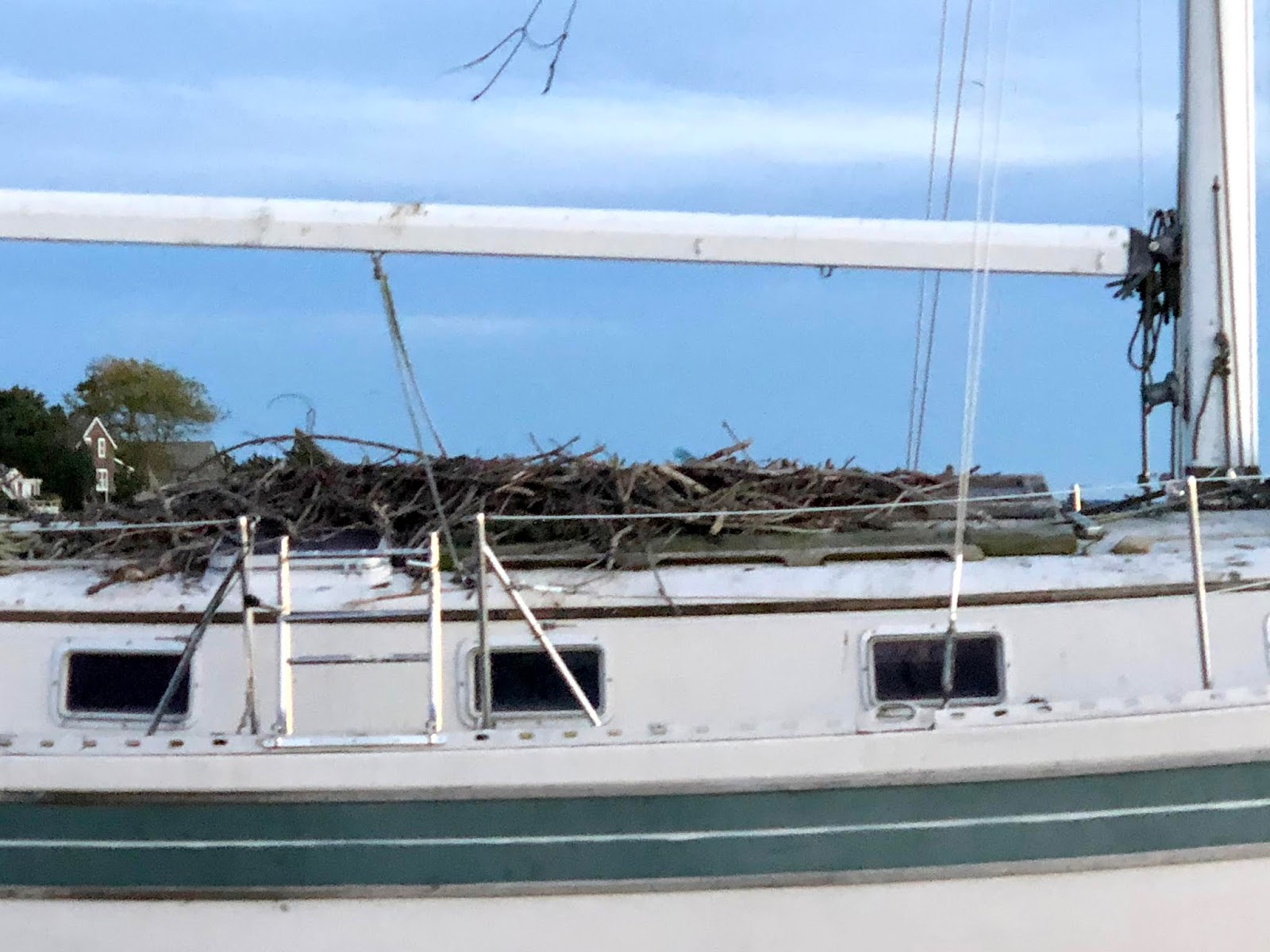
Unfortunately, I was busy at the helm and didn't have time to photograph birds while we were underway, but we spotted flocks of buffleheads, cormorants, terns, gulls, teals and loons.  We didn't see any osprey, but we did find an osprey nest in an unusual place, on the deck of boat anchored and apparently abandoned in Onset Bay.  

Large osprey nest on a sailboat in Onset Bay
We took the dinghy into town.  Most of the restaurants and shops were closed for the season, just as they were on Block Island.  The yacht club was closed, as have been others we have passed the last couple of weeks.  They were taking up the mooring balls in Cuttyhunk Bay as we were leaving there this morning, in anticipation of storms and ice during the winter.  Even though businesses have closed for the season here, the mooring balls are still in place, and there are still quite a few day boats in the water.  We keep expecting to see fall foliage as we sail north, but we have only seen a few yellow-leaved trees, mostly in Mystic, Connecticut.  

After a late lunch/early dinner at the only place open in Onset, a place with acceptable food and lots of local color (not to mention Halloween decorations), we stopped at a little grocery to buy toilet paper because we were down to our next-to-last roll on board.  I will get provisions again in Boston, but I definitely need to do a major shopping trip to Costco before we leave the States in a few weeks.  

Halloween is coming!
There is a waterfront park in town with a bronze statue of a Native American woman looking out over the lovely beach and bay.  Across the street from the park are small hotels and inns.

Native American statue in Onset (Is she thinking, "This used to be our land and water?")
Waterfront hotel in Onset
We dinghied back to Mantra as the sun was setting.  We are holding off on turning on the generator and the space heater until closer to bed time.  I think we will sleep through the night.  The boat is only gently rocking, and the rigging is quiet. 

Sunset from our dinghy, Onset Bay

Monday, October 15, 2018

Cuttyhunk Island, Massachusetts

Brrrr!  It is time to head south but we are still going north.  There are no photos today because it is just too bleak.

On Saturday morning, we woke up to dreary weather, and the wind was blowing 20-25 knots, but in the right direction for a close reach sail from Shelter Island to Block Island, so we set off.  Even with layers of clothing and foul weather gear, I was cold.  My teeth were chattering as I steered into the channel to Great Salt Pond.  I had only been up on deck between departure at 11 a.m. and when we anchored at 6 p.m. (for the sunset!) to raise the anchor, set and trim the sails (2 reefs in the main from the outset) and arrive at Block Island.  Luckily, I had bought additional hot chocolate at the IGA in Greenport.  We may run out before we reach another provisioning location!

The clouds cover the skies
Peter remembered that there was a small space heater in one of the lockers.  We had to run the generator for a couple of hours to use it, but it made a big difference.  I threw beach towels and a quilted mattress cover on top of the thin duvet on our bed, and we were comfy enough.

Sherri frigid at the helm
On Sunday morning, the sun was shining, but it was still 50 degrees F, and the clouds darkened the skies within an hour of our departure at 10:30 a.m.  The wind was less boisterous and excellent for a beam reach sail to Newport, Rhode Island.  We averaged between 6 and 7 knots of speed over ground in calm waters, anchoring in Brenton Cove on the southern end of Newport Harbor just after 3 p.m., having passed the enormous 19-deck cruise ship the Regal Princess at anchor.  On the top deck, on a screen bigger than a billboard, passengers who were addicted to sports could watch Sunday afternoon football instead of getting on a shuttle boat to explore the town of Newport.

Why explore historic Newport when you can watch TV like you would at home?
As we settled in, I did some searching on the Internet and realized that we just had time to make it to Bowen's Wharf for the annual Seafood Festival.  As quick as we could, we got the dinghy in the water and hauled the bigger and more reliable outboard engine out of the forepeak to mount on it.  We made it!  There was still plenty of food, and there were three different bands playing throughout the venue.  After we bought something to eat, we went back to the dock to greet a couple on an Oyster 46 who had hailed us as they sailed by us at anchor an hour before.  They invited us on board. We shared our food, and they provided refreshments.
Peter on the dinghy dock at Bowen's Wharf 
They were docked next to the the S/V Oliver Hazard Perry, a steel-hauled, square-rigged, 200-foot giant.  She looks like an old ship or a reproduction, but in fact she was built in this century and is not a copy of any particular historic ship.  She began sailing in 2015.

Oliver Hazard Perry at Bowen's Wharf at sunset
Steve and Cindy on S/V Willow not only welcomed us on board but invited the boatswain from the Perry to join them.  We traded sailing and family stories and watched the sunset together.  As the oranges and purples were being overtaken by the darkness of night, we left them to walk along the waterfront and find some dinner.  The band closest to the docks was still playing, and we danced to their last number, Shout.
Trinity Church from Bowen's Wharf at sunset
There are many shops and restaurants along the waterfront and some interesting and historic buildings.  We found a little Thai place to eat.  Sated, we walked away from the waterfront one block and then headed north toward Bowen's Wharf, while we had tied up the dinghy, along Spring Street, which is a quiet residential street where most of the buildings date from the days of shipbuilding and whaling.  Our last site was the lovely old Trinity Church.  In the park in front of it, facing the water, the congregation has created an artistically displayed pumpkin patch, with tiny little gourds or pumpkins lining the pathways.

The plan was to get up this morning and dinghy back to Bowen's Wharf in order to read signs everywhere about the history of Newport, stroll along the Cliff Walk to admire the over-the-top mansions ("summer cottages") of the rich elite of New York City (the Vanderbilts and the Astors and others among the 400) from the Gilded Age, and take tours of at least a couple of them.  But we unfortunately had to change our minds when we listened to Chris Parker (our weather guru) and got weather updates online.  Gale force winds are predicted, mostly from the northwest, off and on over the next couple of days.  The southern part of Newport harbor is not protected from winds from the north, and we deemed it inadvisable to stay there when gusts up to 45 knots were predicted.  At 9 a.m., we had the anchor up and were heading east (because we still hope to reach Boston by Friday) to Buzzards Bay in Massachusetts where we could shelter from northerly winds.  We didn't even try to use the whole mainsail; we started off with two reefs.  After we were out in the sound, we hauled the jib partially out, turned the engine off and sailed along at eight to nine knots to with reduced sail.  I would think that a wind out of the south would be warmer, but, NO!  I stayed in the pilot house most of the time, but I steered her into the channel to the Cuttyhunk Pond, teeth chattering all the way.

We dropped anchor at 1 p.m. and have been huddled inside since then.  We ran the generator for a couple of hours in order to use the space heater, so the temperature is tolerable.  Peter and I had a nice game of Scrabble.  (I won, 406-351.)  Sometimes, the wind in the rigging is melodious and pleasant.  When it gets over 20 knots, as it is now, it just sounds ominous.  I will be snuggling into bed early with a book this evening!


Friday, October 12, 2018

West Neck Harbor, Shelter Island, Long Island Sound

The wind picked up to 20-25 knots yesterday afternoon, so we stayed in Greenport for another night. The rain let up for about an hour late in the evening, and Peter and I seized the opportunity to get off the boat and go for a walk about town about 10 p.m.  Except for a couple of bars, everything was closed down for the night and the streets were empty.

This morning, Peter went to the local chandlery, Preston's, to get some new line for the running back stay, and was happy to be greeted by two friendly dogs.  I made another run to the convenient IGA so we are fully provisioned.

Two ferries and the brick train station from Mantra on the dock in Greenport
Shortly after noon, with the wind blowing at 20 knots and gusting to 26, we cast off the dock at Mitchell Park Marina and motored over to West Neck Harbor on Shelter Island.  We gave way to the ferries, which pass each other between Greenport and Shelter Island Heights in the middle of the passage.  A ferries departs from each side of the channel every 15 minutes, and there are always vehicles on board, and another ferry service connects the south side of Shelter Island with the Hamptons.

The amount of ferry traffic is puzzling, because it's not tourist season, and the regular population of the island consists of less than 2500 full-time and part-time residents.  There is a grocery store, a drug store, a book store and two hardware stores, and the island has its own school.  Along the shore sit large, lovely homes with vast expanses of lawns, many of which are only used in the summers.

Well-manicured lawns in front of homes on Shelter Island
It looks like a wonderful place for a vacation or a lifestyle far away from the hustle and bustle of the city.  (It's a 3 1/2 hour train ride to NYC from Greenport, which is the last stop on the Ronkonkoma Branch of the Long Island Rail Road, and the train station is right next to the ferry terminal.)  But why are all these people going back and forth so much?

Here is West Neck Harbor, there are a couple of other boats anchored.  The wind is howling through the rigging at about 20 knots, but the sunlight is sparkling on the choppy bay.  It is a bit chilly, about 60 degrees F, and it is supposed to get down to 48 in the night.  Brrrrr!  We have no heat, so we just layer our clothes and at night we pile beach towels on top of the lightweight duvet because we have no warm blankets.  Thankfully, Amazon will be delivering some to us when we are at a marina in Boston a week from now.


Thursday, October 11, 2018

Greenport, Long Island

Dunes at the entrance to Coecles Harbor, Shelter Island
Yesterday morning, we left Shelter Island and motored the short distance to Greenport on the North Fork of Long Island where we docked at Mitchell Park Marina right in front of the town.  I had called about a week ago to check availability here and was assured there would be no problem getting a slip and so I didn't need to make a reservation.  When I called as we approached, the dock master asked if I had a reservation.  When I told him no, I had been told we didn't need one, he said, "Well, let me see where we can squeeze you in.  I think we can put you on the T-dock on the end of B."  When we tied up, it was obvious he was pulling my leg.  We have certainly avoided the crowds.  Everyone else has hauled his boat out or gone south for the winter.  We are the only vessel in the marina!

Mantra all alone at Mitchell Park Marina
Greenport is a quiet little town, with a base population of 2000 in the off-season.  We walked across Mitchell Park and chose a Guatemalan restaurant for a quick lunch before Pete the refrigeration technician was scheduled to arrive a 1:00 p.m. with our refurbished refrigeration unit.  After the delivery, Peter spent the afternoon putting it in place in the engine room and I went to the conveniently located IGA a block and a half away to get provisions.  We have been out of fresh fruit and vegetables for quite a while now.  I paid $75 for 3 bags of groceries here.  I rememebered that we had paid $10 for 4 bags of groceries in Tulum on the Yucatan Peninsula a year and a half ago.  That is a staggering 10 times as much money for food!

On a pier by the marina is the New York Fire Department Marine Unit 9, which protected NYC harbor for 72 years.  The fireboat was built in 1938.  At the time, her 20,000 gallons per minute pumping capacity made her the world's most powerful.  In addition to extinguishing 50 major fires, she served valiently at the World Trade Center for two weeks pumping water continuously to the fires at Ground Zero in 2001.  I talked for a while to a man working on her, a marine engineer who had served on her for 18 years.

NYFD Marine Unit 9
The sun shone brightly in a robin-egg blue sky all afternoon but just as the sun disappeared, fog descended in the blink of an eye.  The lights of the nearby ferry terminal, which has ferries coming in and out constantly, glowed spooky shades of blue, red, orange and white.

We ate dinner on our boat and then walked the very short distance to town to find desserts or a drink. Before we even arrived on Front Street, we could here live jazz and it was easy to track it down to the   second floor of the Green Hill Kitchen on the corner, where all the doors were opened to the balmy night air.  We found a table outside on the deck, had dessert and wine and stayed for a couple of hours enjoying the music and the atmosphere.  We were perhaps the only non-locals there.  In fact, the enthusiastic audience seemed to be comprised of local musicians and their families and close friends. The music was played not by a single band but by many talented musicians; we had happened upon a jazz jam session!  There were several people taking turns playing saxophone, all with distintive styles.  Other instruments included the trumpet, the flugelhorn, an upright bass, keyboard, an accordion, guitar.  For a couple of numbers, there were female vocalists.  Usually reticent about talking to strangers, I approached some people in the audience who provided me with information on some of the performers.  One man, one of the saxophonists, was having a lively conversation in Italian with two friends.  When another saophonist came by, he switched to fluent Russian.  He also spoke English without an accent, and I learned from one of his friends that he was from Argentina and also spoke Spanish.  I am so envious of such multi-talented individuals!

Jam session at Green Tree Kitchen, Greenport
This morning it is still quite warm although it is overcast and the sky spits drops of rain occasionally. While Peter and Pete worked on the refrigeration unit in the engine room, I walked around town, admiring Victorian houses.  Some of the old mansion This town has more of a lived-in look than the upscale towns of New Shoreham on Block Island and Mystic, although the main downtown streets have plenty of boutiques, antique stores and galleries.  While some houses are well-maintained, quite a few could use some work.  In addition, modern additions have been added to some without consideration of the architecture of the original structure.

A purple house in Greenport
A mustard yellow house in Greenport
A brown shingled house
A blue house with scalloped shingles
Returning to the marina, I passed the blacksmith shop by Mitchell Park, and it was open.  I had a nice chat with the amateur blacksmith, a retired schoolteacher whose other hobbies include woodworking, camping and sailing.  Everyone is very friendly here.

Greenport Blacksmith Shop
Back here on Mantra, the two guys are still working on the refrigeration.  Yesterday, I thoroughly cleaned and bleached out all the mold in the refrigerator, which we have not been using since June, in anticipation of restored refrigeration.  We have been using the freezer as a cooler with ice for the last couple of months.  Now I have taken all the food out of there and we have pumped out the inch or so of water in the bottom.  It is time for me to climb in and thoroughly clean it before it freezes up.

The rains and winds spawned by Hurricane Michael have now moved in.  We have spread towels out on the dining table for the leaks from the overhead hatches, yet another job to be done.  We were thinking of moving back to Shelter Island this afternoon, but we may just stay here on this dock.  Sailing in the rain is wet and not pleasant.


Tuesday, October 9, 2018

Shelter Island, Long Island Sound

The sun was shining this morning, the wind was down and the air was warmer.  After breakfast, the last of our muffins from the Mystic Seaport Bakery, we took the dinghy to the northeast shore of the Great Salt Pond on Block Island. Rolling up our jeans, we pulled it up on the sand and cobbles among kayaks and sailing dinghies beached there.

Picturesque scene on Great Salt Pond (so I took a picture!)
We had hoped to spot some wildlife along the shore, but we could only hear the birds, not see them. Mostly, it was pleasantly peaceful.  We walked along Andy's Way to Corn Neck Road and then walked in the grass beside it, heading north.  The rolling land was divided by stone walls.  There were more trees than on the southern part of the island, although mostly there were open fields and thickets of berries growing among the shrubs.  We passed lovely homes, some with weathered shingles and some in lucent colors bordered with white gingerbread--coconut, butter and strawberry.

House in shades of coconut
Butter colored house with wavy shingles under the gable
The Red House
One of Peter's knees has been bothering him since we were in Baltimore in August, so we turned back to the beach after a mile or so.  Back on Mantra, we put the dinghy engine on its mount on the aft railing, hauled the dinghy up on the foredeck, took off the instrument covers, turned the instruments on, got out life jackets and sailing gloves in the pilot house and opened the logbook.  The engine was on, and in less than 10 minutes, Peter had used the windlass to pull up over 100 feet of chain as I steered into wind, and we set off.  There is a sense of freedom and adventure every time the anchor is free, and we steer for a new destination.  Our destination today was to the west, to Shelter Island on Long Island Sound.  We sailed close-hauled for a few hours with a good wind from the southwest until late in the afternoon when the wind decreased and we had to use the "iron genoa," the engine.

We normally try to anchor before sunset, and we often anchor just as the sun is setting, but we miscalculated today.  (I think Peter forgot that the hours of daylight are getting shorter.)  We watched the sun set over Shelter Island and then made it to the narrow and shallow channel into Coecles Harbor on the east side of the island.  Luckily, the cans and nuns are lighted, and we had just enough light at dusk to see the flow of the current run through the two shoals jutting out into the channel at the entrance.

Sunset over Shelter Island
It is calm in this anchorage; we are well protected from the southwest wind.  We are far enough from the intense night lighting of intensely populated areas, so I am going up above now to enjoy the stars with Peter.