Sunday, February 9, 2020

Back on the Boat, Time to Catch Up on Blogging

Ruins of the Catedral
When I stopped this chronicle, I was writing about our enchantment with Antigua and I left us at the Catedral, so I will re-start from that point in time. After viewing the facade and the main sanctuary of the main cathedral, we walked around the outside, where the ruins of the original and later structures can be seen. The first church was constructed around 1541, was demolished in 1669, rebuilt by 1680 and mostly destroyed again by the Santa Marta Earthquake in 1773, which began in May and continued with aftershocks until December.

Inside the Catedral
Catedral ruins
As we continued along, we were sometimes passed by the local "chicken buses," colorful vehicles, sometimes crammed with people inside and loaded with parcels and luggage on top. A man jumps on and off, often while the bus is not fully stopped, to help load and unload passengers and goods. These buses belch diesel fumes as they speed up or struggle up hills and mountains. They are the main means of transportation for locals and intrepid backpackers traveling across the country. (We are not quite as intrepid as we used to be; we rented a car.)

Chicken bus
On the way back to our hotel from our early morning walk for breakfast, we passed by the ruins of Iglesia del Carmen, where everyday local vendors spread out their wares, mostly textiles, across the cobblestones.

Vendors in front of Iglesia del Carmen
At our hotel, Casa de la Alameda, we ate a typical breakfast which began with avena con leche, a warm, sweet, oatmeal-based drink served in a mug, a delightful and unexpected start to a delicious meal. The main course consisted of eggs scrambled with diced tomatoes and onions, fried plantains and black beans boiled down to a paste. Although warm tortillas are usually served, we had bread.

Typical breakfast
After a short rest in our hotel, we set out again about 10 a.m. for further exploration of Antigua. We strolled past La Merced again and passed by the 17th century Santa Catalina Arch, constructed to allow cloistered nuns to walk from the convent to the school and an orchard and garden without going out on the streets.

Santa Catalina Arch
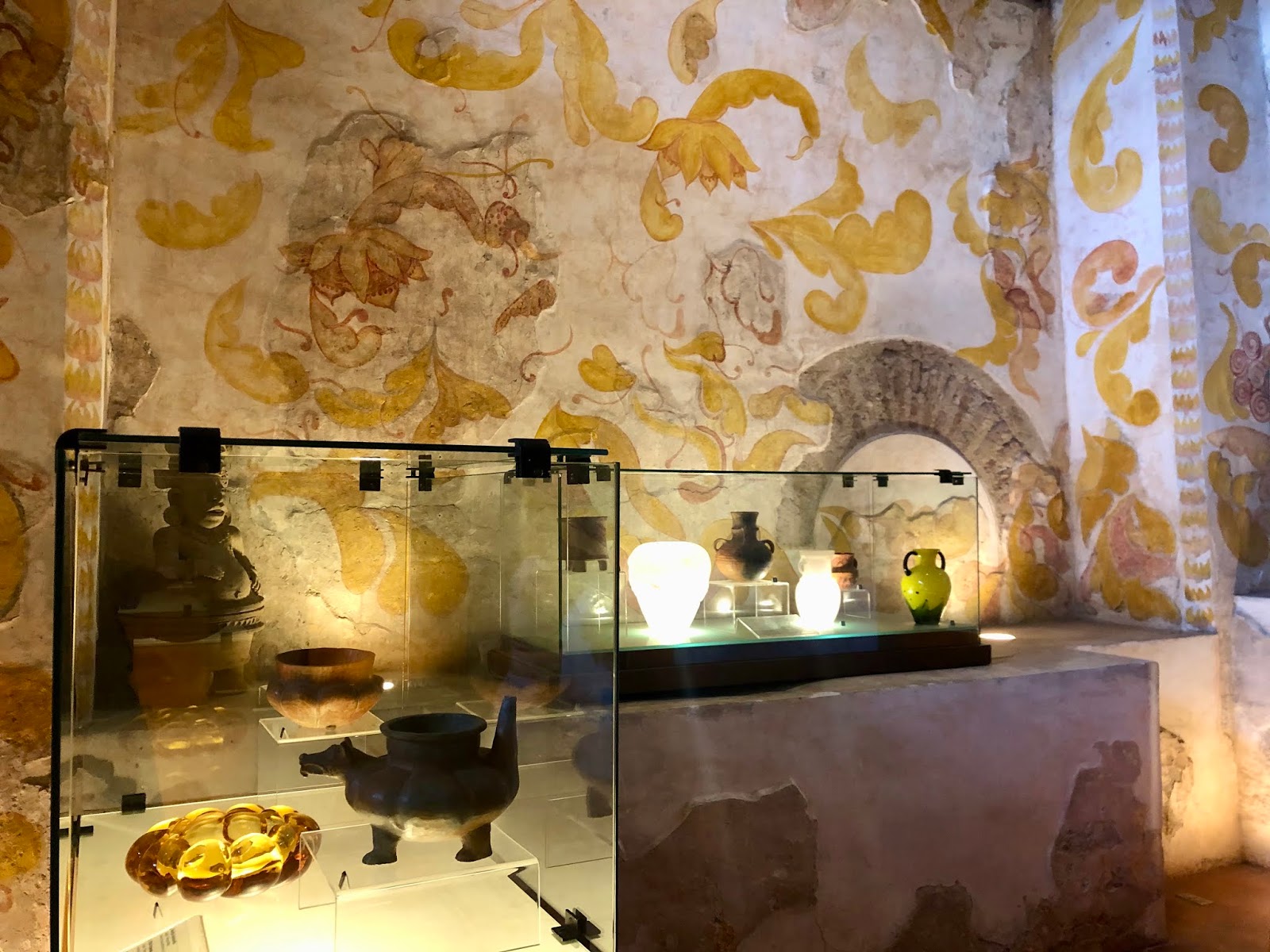
Our next stop was the ruins of the Santa Domingo monastery and church complex, which was established in 1538 and, like so many structures, was partially destroyed in the 1773 earthquake. Now, the extensive property houses the luxurious Hotel Casa Santa Domingo (the restored convent) and the former Santo Tomás de Aquino College (now San Carolos de Guatemala University), two institutions which were once one; they mutually administer multiple museums and the ruins.  There is a replica of the original oval-shaped fountain in the main courtyard as well as the remains of two underground crypts, chapels, a kitchen and other structures. In addition, many of the rooms have been converted to small museums, including a pharmacy museum, a museum of arts and crafts of the Sacatepéquez area, and archeology museum, a modern art gallery, a music salon, the museum of Precolombian Art and Modern Glass, and museum of colonial art. We spent a lot of time in the Precolombian Art and Modern Glass museum, where ancient pieces, including urns, statues and jewelry are displayed juxtaposed to modern art works in glass from around the world, highlighting the similarities in form, decoration and use. The back part of this exhibit hall was formerly a chapel, and the some of the murals of the interior walls are still intact. In Marco Augusto Quiroa Hall, the works of modern local sculptors in various media were arranged beautifully and complemented exposed excavated foundations beneath the room, covered in glass flooring. Walls and facades were still laying on their sides just as they had fallen in massive blocks almost two and half centuries ago. In the archeology museum, stone and ceramic objects from the Classic Period of Mayan culture (200-900 A.D.) are exhibited and include figurines, vaes, plates, bowls, funerary urns and ceremonial hatches and yokes. The informative arts and handicraft museum displayed and explained objects including textiles, toys, kites, candles, painted ceramics, wrought iron work and pieces demonstrating carpentry and cabinet making skills. In the pharmacy museum are 19th century furniture and cabinets as well as porcelain, marble, glass and bronze pieces that were once used to store and produce medicinal products.

Fountain in the main courtyard of Santa Domingo
Insect artwork in the contemporary art section
Precolombian Art and Modern Glass exhibition with stucco walls showing floral designs (Darker parts are original.)
There was a honeycomb of crypts under the ground level of the complex, and a few have been excavated and made accessible. Particularly outstanding is the polychrome stucco scene of the crucifixion in the Calvary Crypt, dated 1683. 

Out on the streets again, we encountered many Maya women selling their textiles, and we finally succumbed to a persuasive girl near the Santa Catalina Arch. These women all were wearing traditional, pre-Colombian dress, but not necessarily to provide photo ops for tourists. Even in the non-tourist sections of the city as well as in the surrounding area of western Guatemala, almost all the women still wear the traditional huipil (a loose rectangular blouse) a wrap-around skirt, an embroiled textile belt, and a tzut (a shawl that doubles as a multi-purpose carry-all). The bright, multi-colored pieces of clothing are created on traditional hip-strap looms. The warp of the cloth is attached to two rods, one attached to a tree and the other to a strap that goes around women's hips, allowing them to adjust and control the tension. Sticks are used to separate the warp yarns and to interweave the weft. During the weaving process, the women hand-embroider designs, traditionally bird, animal and plant motifs, to make elaborate and intricate patterns recalled from memory, without the use of patterns.

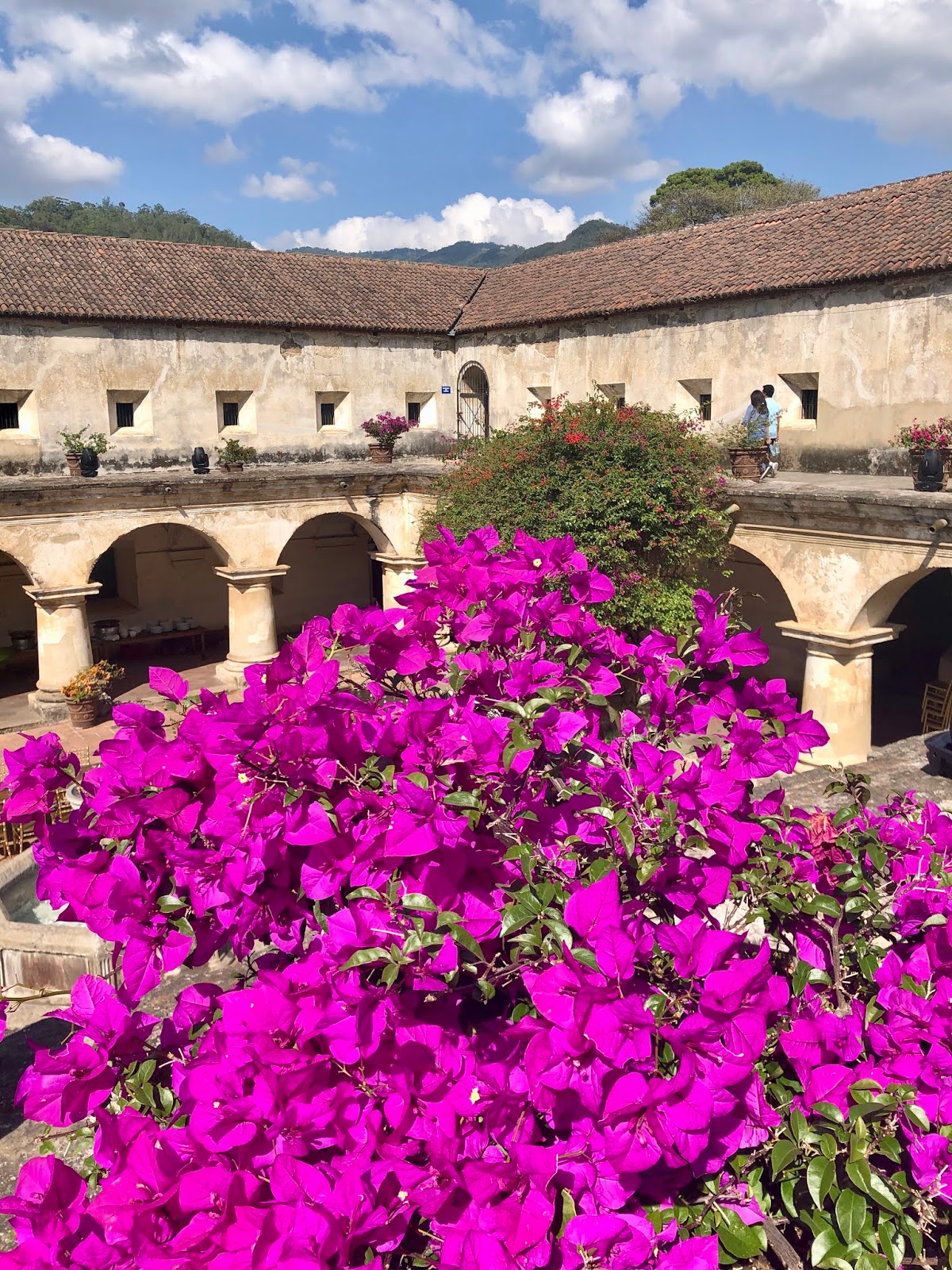
Our next stop was the Church and Convent of the Capuchins, a extremely severe splinter group of the Franciscans. Nuns were permitted no contact at all with the outside world. In terms of the architecture of these 18th century ruins, the most intriguing is the Tower of Retreat, a circular building with a central raised courtyard surrounded by 18 small cells which would have furnished with a cot, perhaps a desk and an altar where the nuns could sequester themselves from each other for study and prayer.  In contrast to the austerity of the convent when it was in use by the Capuchins, an expensive and elaborate wedding reception was being set up in the main courtyard, with an over-abundance of food, popular music, and numerous glamorous floral arrangements.

Convent of the Capuchins ruins
Courtyard of the Convent and Church of the Capuchins
We wandered into the Cocoa Museum, which had interesting displays and clearly explained the process of making chocolate and other cocoa products, but we had already learned these details in Cartagena and at the cocoa farm in Panamá in our travels last year. We did stop for a beverage in the courtyard and our eyes were once more delighted with the vivid colors of textiles for sale.


Textiles for sale
(Break now:  This is taking hours because of Internet speed.)  (Now I'm back.)

Public lavaderos
Continuing our perambulation, we passed through Parque Central again, admired more exampoles of Baroque architecture, and walked along colorful, quiet side streets until we came to the Church of San Pedro Apostal, then the public lavaderos (where local women still come to do their laundry in the alcoves), and finally the ruined facade of the Sanctuary of San Francisco el Grande, with its twisting columns and the remains of the bell and clock towers. Inside, the popular church is spacious, with teal walls and white columns along the nave ending in a multi-storied gilt altarpiece in the apse.

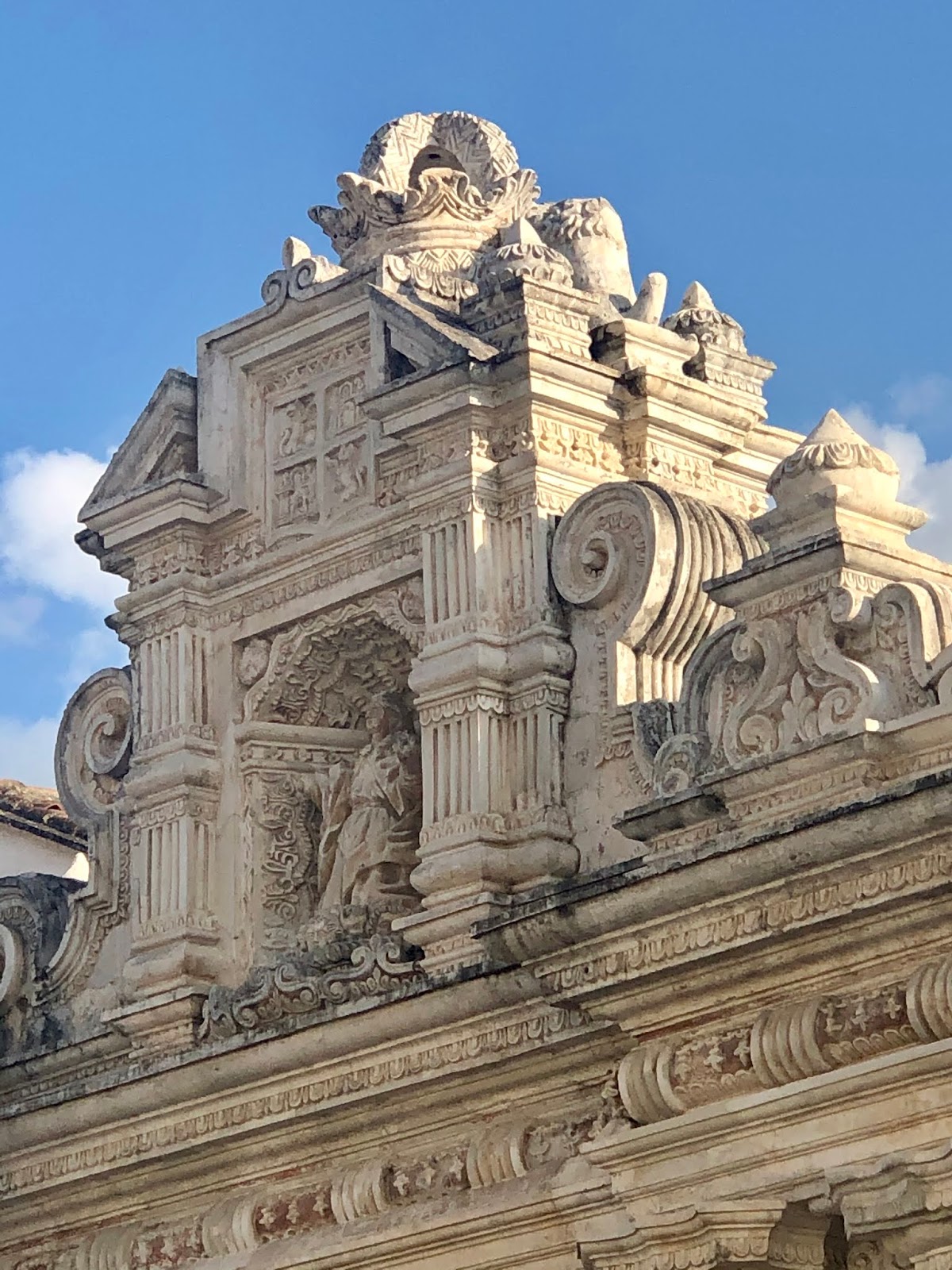
Yet another example of Baroque architecture 
Facade of the Cathedral in the afternoon light 
Typical side street in Antigua
Parque Central
Church of San Pedro Apostal
Altar, San Francisco el Grande 
San Francisco el Grande
By now, we were hungry, and we went back to a restaurant we had passed earlier in the day which had appealing, colorful food enticing people walking along the cobblestone street. A man behind the array of pots and pans and bowls filled with appetizing selections fills your plates as you indicate what appeals to you and then another man carries them back to the courtyard seating area behind the street-side kitchen. (The name of the restaurant is La Cuebita de Los Urquizú.)

Yummy vegetarian stuff
Various meat stews
Well-nourished and revived, we decided to climb up to the Cerro de la Cruz to get a view of Antigua from above before darkness descended. We were surprised to find the park around the cross crowded with people, mostly locals, there to enjoy the sunset. 


Volcan de Agua looming over downtown Antigua
After that, we returned to our hotel. I had hoped to blog while the memories were fresh, but I was really tired and the comfortable bed beckoned.

On Sunday morning, after another typical breakfast, we drove to Chichicastenago, famous for its twice weekly market where vendors sell textiles and yarn; fresh flowers; local produce, meat and fish; and ground limestone. The Maya add lime to water when they cook corn because it improves the nutritional value; it softens the kernel, releases the germ and converts nutrients such as B vitamins and amino acids into a form more readily absorbed by the human body. 

The stalls, which are erected on either side of the streets and throughout the central plaza, are carried in pieces on the backs of men, women and children in the hours before dawn in preparation for the throngs of people, mostly Maya from the surrounding area, although the tourist trade has increased, meaning there are more textiles on display than needed by the local population. We were amazed at the sheer volume of everything. By mid-day, the supplies did not seem to be depleted at all, and we wonder how they actually make any money while maintaining such a large inventory. And where does all the fresh food go if it is not sold? 


Produce for sale
Chichicastenango market
Maya woman in traditional attire
Textiles and clothing in the market
Fish for sale
Farmer selling beans
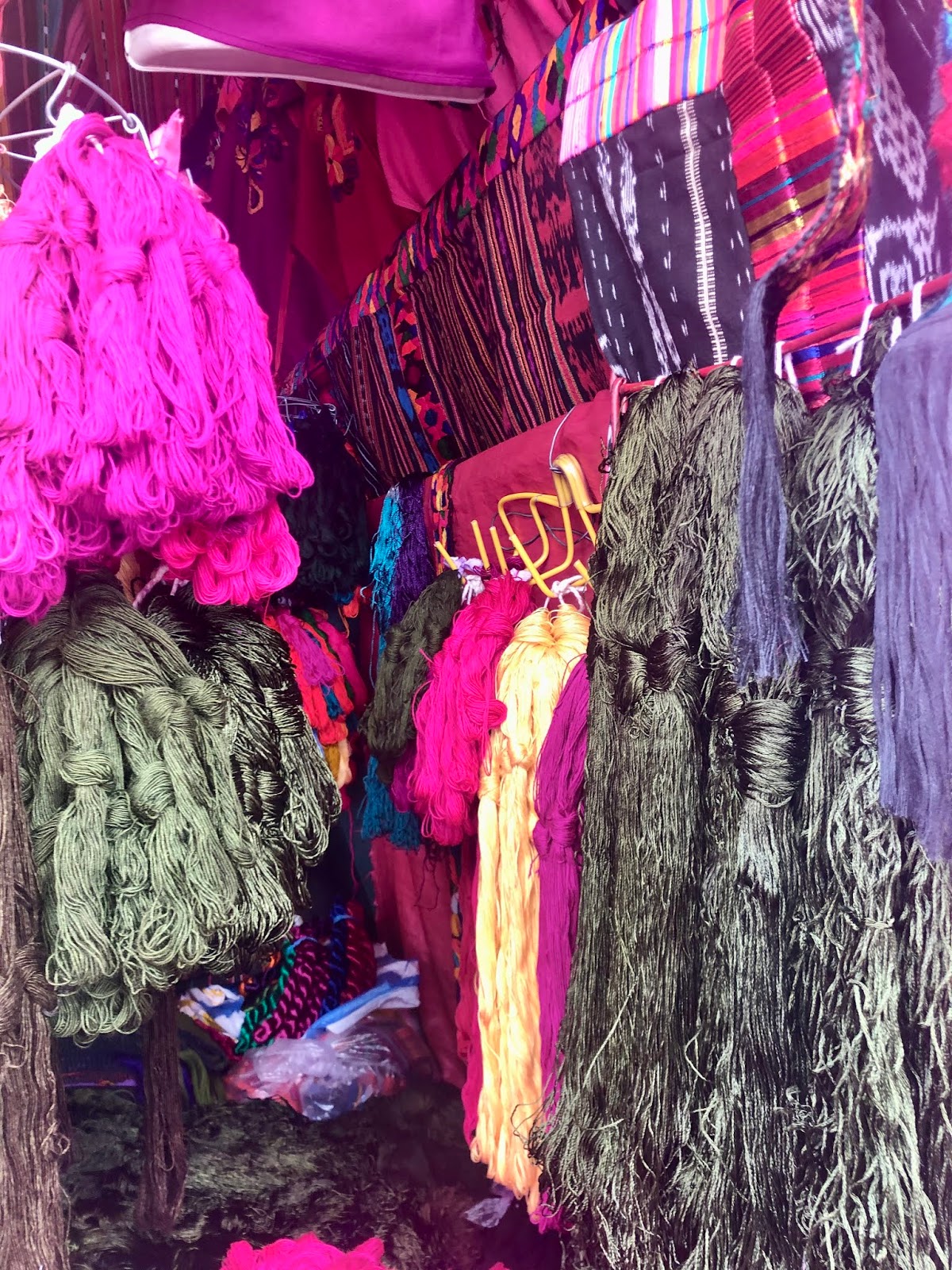
Colorful yarns and fabric on sale
Varities of maize
Main breaking up limestone to sell for cooking with maize
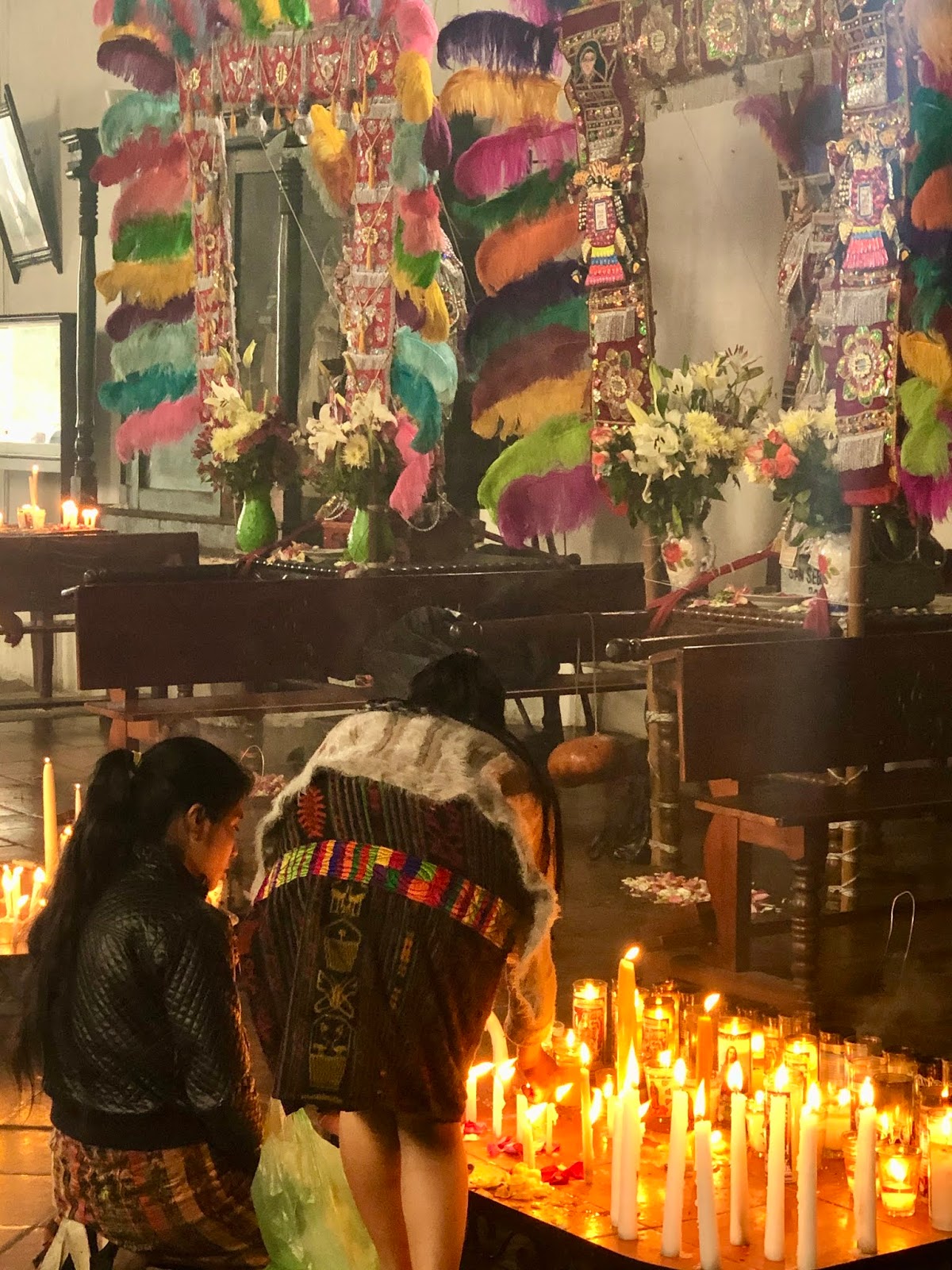
We went into the church on a corner of the central plaza, the whitewashed Church of San Tomás. It was built around 1545 on top of a Pre-Colombian temple platform, and the existing steps originally led to a temple and are still venerated by the Maya. K'ichi' Maya priests use the church for their rituals. Incest was being burned outside the portal, and inside the sanctuary was filled with smoke from burning candles and incense. Triptychs and other sacred decorations were coated with black carbon residue from the offerings; I suspect some are quite colorful under the grime. Along one side of the nave were three separate altars with icons of saints, bordered by colorful feathery arches. Each had its own large, low metal platform in front of it for candles, and people also place offerings of liquor, flowers and corn. As we had seen in other churches, a congregant took responsibility for scraping off the melted wax and making room for more candles.

Bright polychrome statues contrast with smoke covered paintings and ornamentation
A woman placing a candle in front of one of the shrines
smoke-filled sanctuary of San Tomás
Two of the altars and numerous candles 
The main altar in the apse of the church
We also visited a small museum along another side of the plaza. In addition to archeologic relics and a room of portraits of previous civic leaders, there was a large wheel demonstrating the Maya calendar. Actually, there are three separate calendars. One has 20 named days interlocking with the numbers 1 through 13 for a total cycle of 260 days, each of which has a special meaning and requires specific rites and rituals. Another system, based on the sun, has 18 months, each 20 days long. Five days are added at the end of the solar cycle to make 365 days, but these 5 days are regarded with dread and only the intervention of priests can prevent disaster. These two systems are intermeshed to make a cycle of 52 years. Then there is the Long Count, which apparently was developed during the Classic Period of the civilization to distinguish long periods of time. It is also cyclical, starting over every 5125 years.

Depiction of Maya calendar
Another fascinating stop was a smaller church on the opposite side of the plaza from San Tomás, El Calvario. Although no one was present, it was obvious people had been busy preparing a float for Santa Semana, or Easter Week, when in every town there are numerous processions.

After lunch, we drove back along the 12-kilometer mountainous road to the main highway (the Guatemalan section of the Pan-American Highway). Suddenly, the traffic came almost to a standstill. We wondered if there was an accident ahead, but as we made our way forward up a steep grade, we passed the cause of the slowdown, a religious procession taking up one side of the two-lane road. Actually, we were delighted. We had read about the Cofradías before going to Chichicastenango. Each of these brotherhoods is dedicated to a Christian saint, and they carry the image of the saint in processions through town and, apparently, from one village to another. To be selected to be a cofrade is a great honor, reserved for respected males of the community. It also requires financial resources since the colfrades are expected to contribute toward the village celebrations and annual fiesta, providing costumes and alcohol, an maintain the saint's image. Although the cofradías are associated with the Catholic Church, they also continue Maya religious customs, including the keeping of the calendar and worshipping Maya dieties. Because of this integration of pagan beliefs, since the 1950s the Catholic Church has discouraged these organizations and the centuries-old community tradition is not as strong as it used to be.

Religious procession up a mountain with comfrade carrying the image of a saint 
Decorated trucks waiting to join the procession
Having left this interesting piece of culture behind us, we quickly made it to Panajachel, where we parked the car for a couple days and made our way by ferry to a boat-only accessible lodge on the northern side of Lake Atitlán near the village of Santa Cruz de Laguna. The lake is surrounded by three conical volcanos and its shores are home to 13 Maya villages. Around 12 million years ago, a giant caldera, much larger than the present lake, was created and around 9 million years ago a slightly smaller, bowl-shaped caldera fromed inside it. Lake Atitlán is the result of third enormous volcanic eruption 85,000 years ago which blocked water flowing from the lake. The lake, 5125 feet above sea level, is fed by three rivers. For unknown reasons, the level of the lake has risen about 6 feet in the past two decades, submerging docks and beaches around the lake.

Our accommodation at Sunset Atitlán Lodge was idyllic. For two nights we stayed in the Tree House, a two story apartment with magnificent views of the lake. The host and the staff were helpful and interesting, and we enjoyed getting to know them and the few other guests at communal breakfasts and dinners. On our only full day there, we walked along the shoreline for about a half hour to reach the village of Santa Cruz. The heart of the village is half way up the mountain, and we hired a tuk-tuk to transport us to a place called CEPAC and its restaurant, Sabor. CEPAC, supported by an American NGO, offers training programs in cooking, sewing and others skills to the young people of the area, helping them to gain skills to rise above poverty. We were impressed with what they are doing as well as the delicious meals we were served. From the rooftop restaurant, we could also peek into the everyday lives of the local people on the streets and their back terraces.

Peter enjoying the hammock on our private terrace
Sunset from our terrace 
Peter paddle-boarding on the lake
Afternoon view from our terrace
View from the restaurant 
Sherri at Sabor
Woman working on her back porch
After lunch, before walking down the steep road to the docks, we took a peek into the church on the main plaza, a simple structure with white-washed walls inside and out. Red and white cloths were draped from the rafters. Along the walls surrounding the altar, there were various carved wooden statues, most with fading and chipped paint, and the altar itself was full of flowers, offerings and small icons.

Draperies brighten the interior of the church in Santa Cruz de Laguna
Statues lining the walls 
Statues lining the walls
Altar of the church
The plan had been to explore some of the other villages around the lake during our short stay at Atitlán, but we found that just relaxing at the lodge and enjoying the lake were just too enticing.

View from the lakeside trail, showing submerged terraces and our lodge on the far right
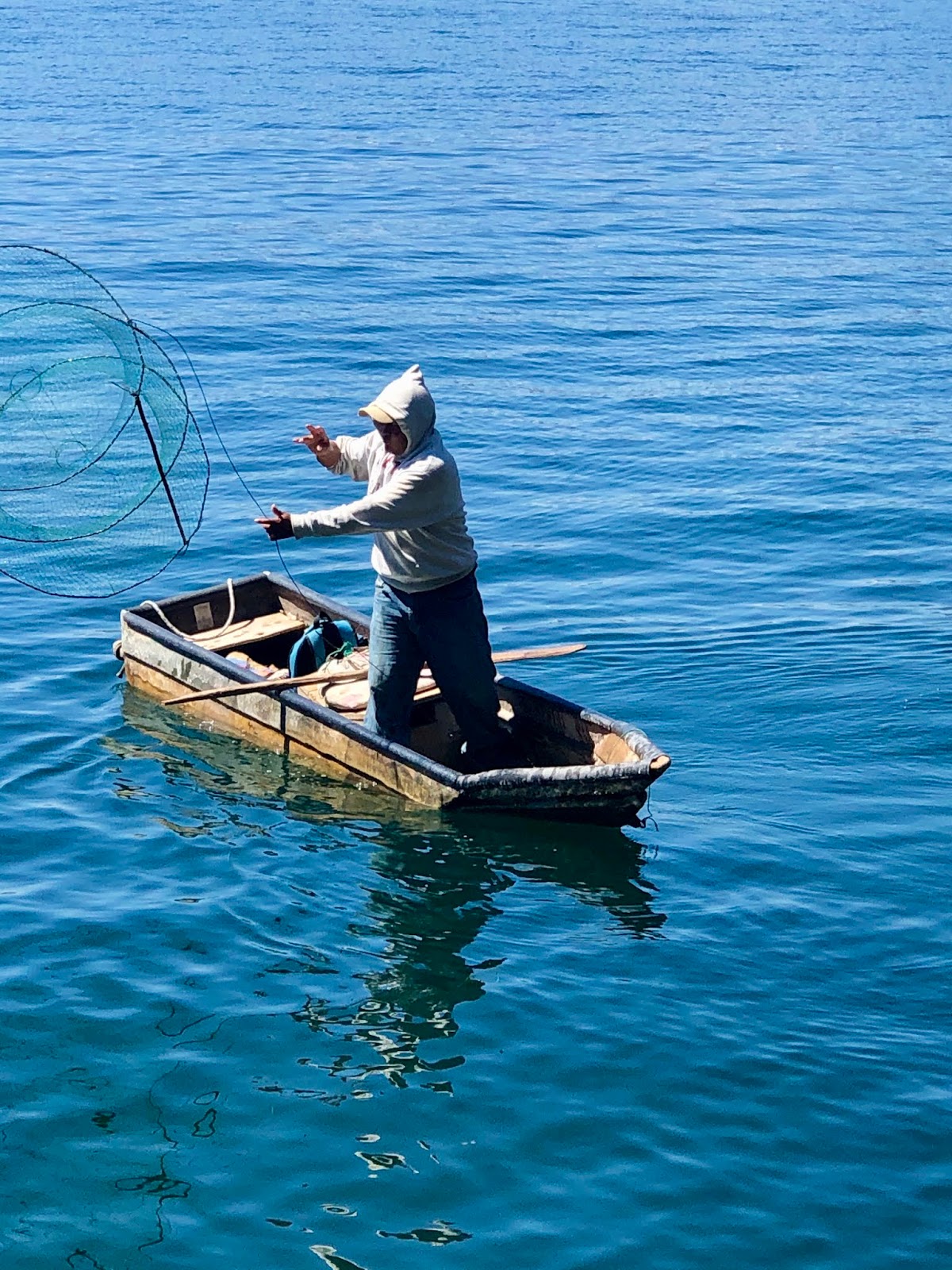
Man fishing in front of the lodge's docks
With reluctance, we left this restful and scenic place to head further up into the western highlands. We were expecting to encounter beautiful scenery and traditional villages. Unfortunately, before the day was over, we wished we had never departed from the lake. For most of the hours-long drive, we were on the Pan-American Highway, and commerce, industry and concrete and corrugated metal roof housing border each side. The cities and villages seem grubby, polluted by the exhaust of the big trucks constantly rumbling through. Regularly, large sections of the land right beside the road are gouged out. Stripped of all vegetation, the quarries for rock and sand scar the hillsides. The steep mountains have long lost more than half of their forests, it seems, replaced by terraced fields where the Mayas, who make up a significant percentage of the population of this region, plow, plant, tend and harvest their crops without help from machines or animals. The small patches of various shades of brown, tan and green create crazy quilts draped over the mountainsides. This somewhat attractive picture does not disguise the blight of deforestation. Where there are not farms, there is urban sprawl. It seems obvious that the size of the population cannot be adequately supported by the resources available, and the recent drought has only exacerbated the poverty and malnutrition that plagues the people. They crowd into the cities seeking opportunities that are just not there or push their way further up the mountains, trying to eke out basic sustenance.

Centuries old facade of cathedral in Quetzaltenango that survived a 1902 earthquake
Post-earthquake interior of the cathedral
Three small old women carrying firewood through a village
Finally, after having stopped for lunch at Quetzaltenango, hours later we arrived at Huehuetenango, high in the mountains, where we zigzagged through the narrow streets until we reached our hotel and shuddered in shock at the sight of an ugly multi-story Western building boldly advertising Bingo on its facade, plunked down in the middle of one and two-story typical Guatemalan buildings. I wasn't expecting much of Huehuetenango, but I thought I had booked us for two nights at a resort with lovely grounds from which we could easily do day trips to ruins and some of the most traditional villages (according to the guidebooks). It was not the sort of place I would even have chosen in a first-world country. Our room was large and comfortable but without any real style, and the businesses all around were shut up. Hungry, we had hoped to find a local restaurant, but we ended up having dinner at a replica of an American fast-food restaurant, complete with a play place for kids.

The staff were wonderfully helpful and breakfast was delicious, but we just could not stay. After our meal, having quickly booked another hotel for the second night back in lovely Antigua, we checked out without even asking for a refund.  (Well, hotels are inexpensive here in Guatemala.) Before leaving the area, we did visit the local ruins, Zucaleu.

Zucaleu (which means "white earth") is a Maya archaeological site on a small mesa which was first occupied in the Early Classic period (250-600 A.D.). The largest structures at the site, however, date from the Classic period (600-900 A.D.), and plazas groups and buildings were added during the Early Postclassic period (900-1200 A.D.) and the Late Postclassic period (1200-1525 A.D.). Since its beginning, it has an unbroken history and is still used by the Mam Maya as a ceremonial site. The Mam controlled the region for centuries, before they were invaded by K'ichi' Maya with their allies, the Kaqchikel, sometime during the Late Postclassic period, and their is evidence of Mexican cultural influence and perhaps domination before this time.

During the Spanish conquest of the area led by Gonzalo de Alvarado y Contreras (brother of the cruel conquistador Pedro de Alvarado), Maya warriors, under the leadership of Kaibil Balam, defended Zucaleu for four and a half months before they were forced to surrender because of starvation (and cannibalism), in October 1525 A.D.

Zucaleu has 43 structures arranged in small groups around 8 small retangular plazas. The buildings were constructed of masonry which was covered in a thick layer of plaster. The pyramid-shaped temples usually have steep double stairways. Remnants of floral and geometric designs indicate that these walls were colorfully decorated. Unlike other ancient Maya sites, Zucaleu has not stellae or hieroglyphics.

In 1946, the Guatemalan government licensed the United Fruit Company to excavate the site. Unusually, the archeologists chose to re-plaster some of the structures in the manner that would have been used in the original construction. The excavations uncovered ceramic vessels, anthropomorphic figures, pyrite mirrors, tools made from obsidian, and beads and earplugs (some unbelievably large) of turquoise and jade. Also found were gold, silver and copper objects, indicating that the Maya in this region were involved in trade networks spanning Central America. Many of these objects are now on display in a small but informative museum at the site.

Zucaleu
Zucaleu
Zucaleu
After our visit there, we headed back to Antigua, arriving there mid-afternoon. Our hotel, Hotel Eterna Primavera, just a couple of blocks from Parque Central, was amazing. Incorporating remaining structures from an earthquake-destroyed early colonial casa, the small hotel is modestly elegant. The rooms all face the central courtyard which seems to be practically overflowing with green and flowering plants (although, it is, in fact, carefully manicured). Our room was beautiful. After settling in, we set off to find afternoon tea. There were many options and after a stroll past several cafes, we chose Roots, where I enjoyed homemade tomato soup and a grilled cheese sandwich made with rosemary bread and Peter had a huge piece of poppyseed and raspberry cake.

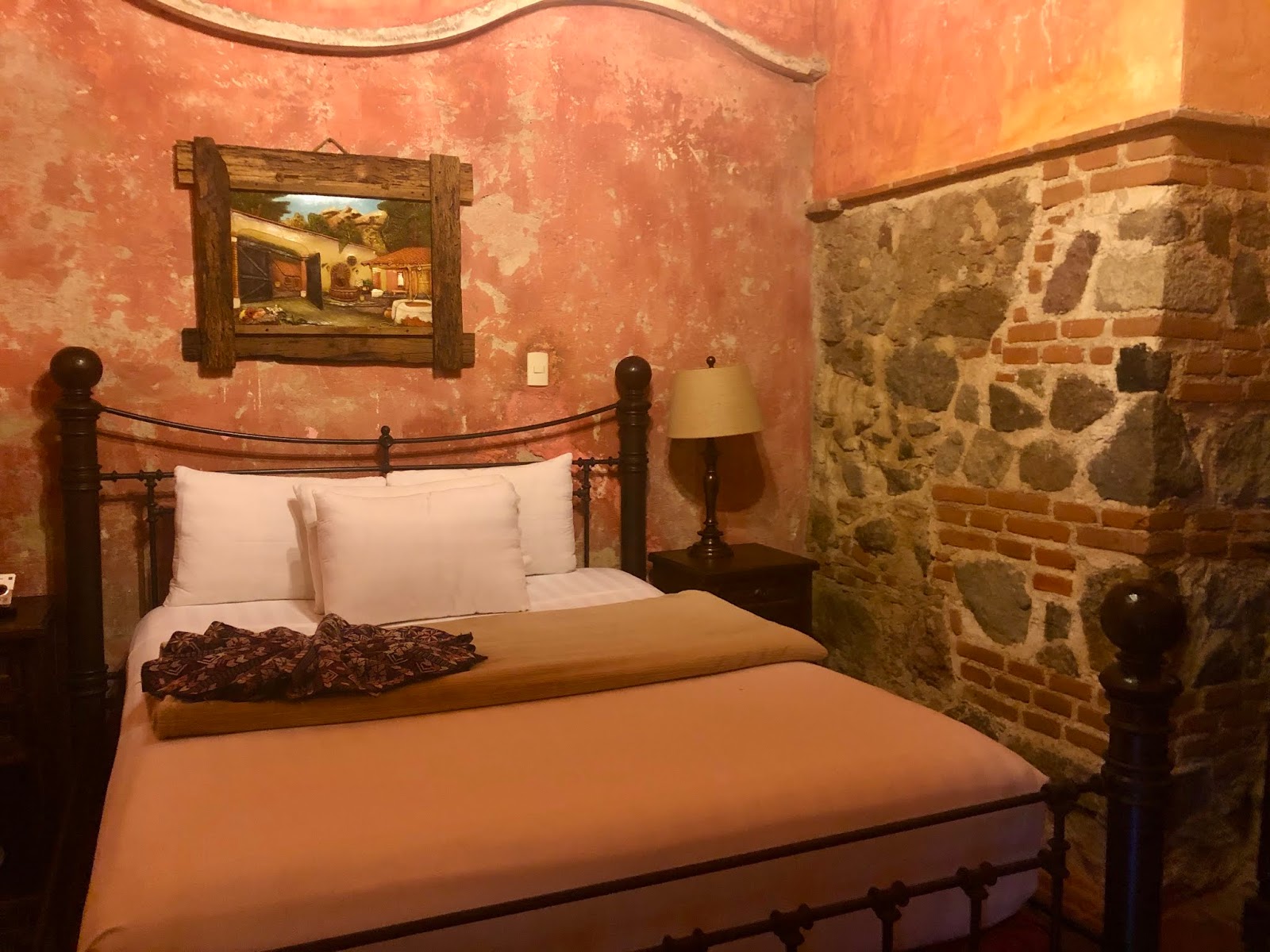
Our delightful room


Courtyard of Hotel Eterna Primavera
Steam and smoke of El Fuego, an active volcano, from the roof of our hotel
That evening, we walked about and found a restaurant for dinner, Frida's, which is decorated with large reproductions of Frida Kahlo's works. The Mexican food was great, and a solo musician enhanced the delightful ambiance of the place.

Frida's Restaurante
The next morning, after a delicious breakfast al fresco in the courtyard of the hotel, we went for walk along the cobblestone streets, having an hour or so before we had to leave town. We found ourselves drawn in to a jewelry shop and museum, the Casa de Jade, where we were helped by a nice young man named Berny. The museum, of course, is situated in the rear of the establishment, making it impossible to avoid admiring the stunning jewelry on display in the successive small rooms of a former large casa. The museum itself has a fine collection of artifacts dating back to the Olmecs.

After looking at the Olmec and Maya pieces from excavations around the country, we went into shopping mode and selected a few pieces. We had to pass through the central courtyard to get to the front of the store, and we stopped there to admire the textiles of two Maya women. With Berny helping with translations, we chose a piece and also asked if one of them would show us how to use the hip-strap loom, which she graciously did. It was fascinating to watch her methodical work as she wove and embroidered from memory. When we paid her for our purchase, she reached up and sweetly gave me a big hug!

Hip-strap loom
Weaving in the weft yarns across the warp
Maya woman adding embroidery
Unfortunately, it was now time to leave (although we stole a few moments to buy a couple items at a chocolate shop), so we returned to our lovely hotel, packed the car and went to the airport where we returned the vehicle and met our driver, Will Jose, from Ottotours in Río Dulce. Seven and a half hours later, with only a brief stop for food, we arrived at Sundog's, one of the main cruisers' hangouts, where we were met by the lancha from Boatique. Finally, after tedious hours of traveling, we reached on second home, our boat Mantra.

Now we are enjoying this lovely, beautifully designed new hotel and marina which is peaceful but not silent--there are lots of animals around. We are getting ourselves and the boat ready to cruise again in a couple of weeks. We have done initial provisioning at the new, large supermarket in town. Peter has been focusing on getting our cantankerous generator to operate reliably, trying to track down where air is leaking into the system. I have been cleaning. At dusk, we go and enjoy the new pool, from where we can watch the fireflies in the fields and listen to the continuous music of various insects, frogs and toads, punctuated sometimes by the barks and growls of the howler monkeys.

The local vendors on the street have a better selection of produce than the supermarket
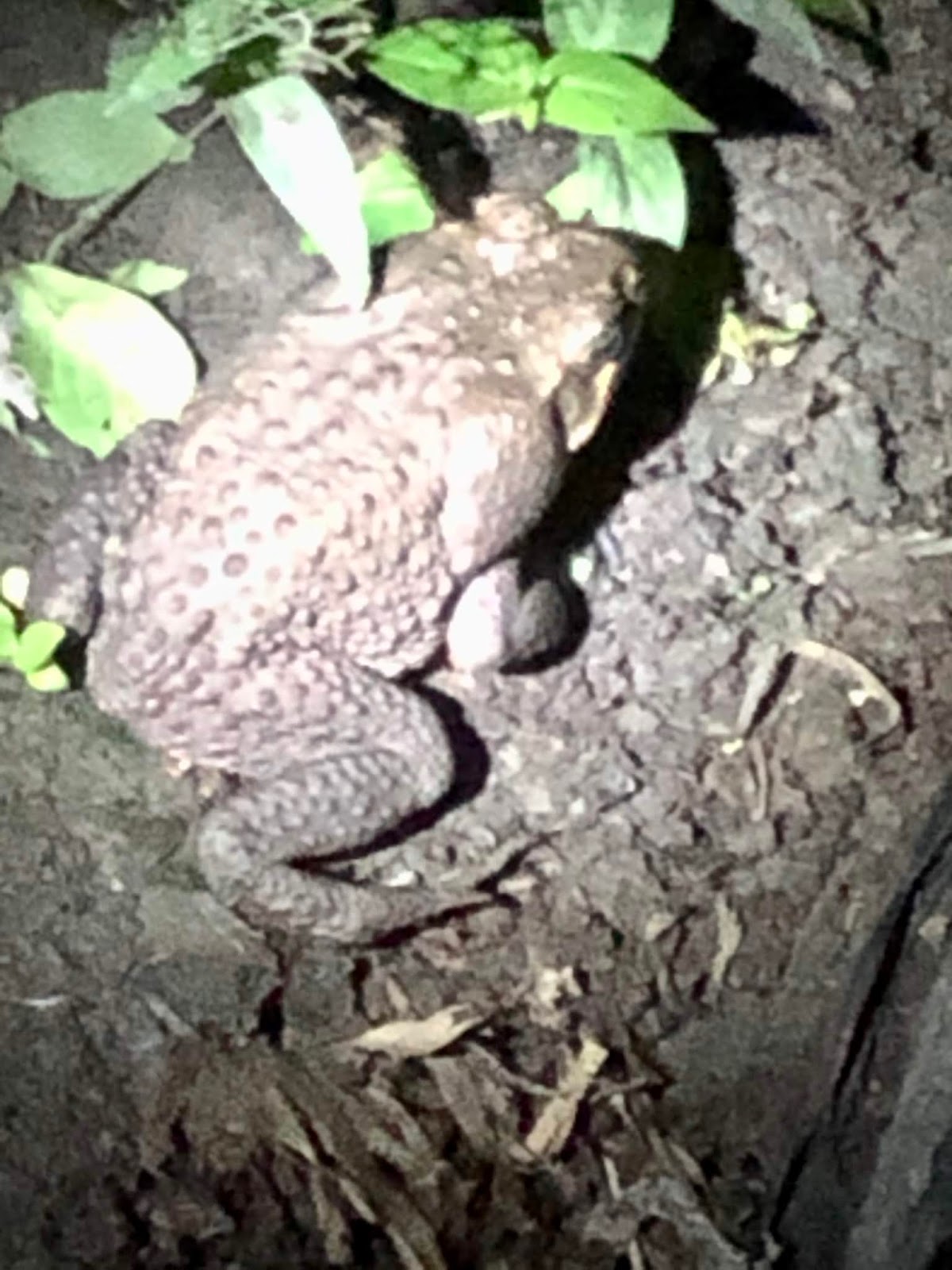
Toad below the raised walkway 
Boatique's pool
Mantra on the dock
The hotel itself, a collection of various-sized palapa covered wooden structures connected by raised walkways over the backwaters of the river, hosts 30-something backpackers and families, and we enjoy conversations with them in the outdoor restaurant, where the food is sublime.

In working on the boat in the last couple days, Peter has developed a list of hardware and supplies he needs, so we will be heading into town again on the dinghy as soon as I take a dip in the pool.



Monday, February 3, 2020

Guatemala off the Grid

Slow to none would adequately describe our access to the Internet over the past couple of days. We are having a great time exploring the western highlands of Guatemala. We have been active but not frenetic, relaxed but not lethargic. The days have been full of new experiences, and we have been learning a lot about the Mayan culture in the area. However, it is once again getting late, so I am going to have to postpone writing about our adventures until another time. In the meantime, here are a few photos.

Or, perhaps not. I just tried to upload some photos, and it is just not happening. Some day soon, I will have high-speed Internet!

Saturday, February 1, 2020

Antigua, Guatemala

Peter and I have left the beauty and comfort of our home in Gold River and abandoned our friends and our daughter again, off to see more of the world. We flew to Guatemala City yesterday (Friday, Jan. 31) and picked up a rental car and a passenger! There was a nice young man from British Columbia seated with us on the flight from Houston. He was also heading for Antigua but had no arrangements for getting there from the airport, so we invited him to join us for the ride. Traffic in Guatemala City was horrible, and taking side streets did not seem to help, but we finally escaped the congestion and smog after sunset and then made it quickly to Antigua. After dropping Luke off at his hostel, we drove to our hotel, which is in a lovely old colonial home with a central courtyard. We were too tired to go out for dinner even though we were hungry, but the hotel staff prepared a basic meal for us.

This morning, we were out on the cobblestone streets by 7:30. Laid out at its founding in 1543 as the third capital of Guatemala (which included Belize, Honduras and El Salvador then) on a north-south grid of surprisingly wide streets and avenues, historic Antigua is easy to navigate (although the cobblestone streets are not necessarily easy on the soles of the feet). Throughout the day, we visited many churches, which is practically unavoidable since there are, in fact, many churches, at least one every two blocks. The first was Iglesia de la Merced, which opened in 1767. The interior, like most of the churches, is stark white with minimal ornamentation other than the main altar and the alters in chapels off the nave. The exterior, particularly the front facade, however, is truly Baroque. Almost all the Catholic churches in Antigua are designed in what is referred to as the Squat Baroque style, with substantial foundations, large buttresses and impressively thick walls and columns. La Merced has perhaps the most beautiful exterior; it is painted golden yellow and highlighted with white filigree-like designs.

Facade of La Merced
Main altar, La Merced
The church, like most of the buildings in Antigua, sustained damage during the earthquakes and tremors that shook the city but survived the devastating one in 1773, the fifth large quake in that century. The extensive destruction in 1773 caused the Spanish Crown to abandon Antigua and create a new capital in Guatemala City. Although most of the 60,000 to 70,000 inhabitants left, a few stayed and cultivated the surrounding hills. Eventually, in the 19th century, the population grew again. Fortunately, the people chose to maintain the historic integrity of the structures, rebuilding in the same style and leaving some ruins for their cultural and historic value.

Our next stop was the market, a large city block of criss-crossing dark alleys with colorful goods spilling out of every stall and tiny store. This is where the locals shop for everything--food, clothing, household goods, toys, pet supplies, tools and other items. We only stayed long enough to absorb the atmosphere and then came back out into the sunshine. As we walked toward the Parque Central, we passed the ruins of an enormous Catholic complex, built between 1690 and 1698, built on land that belonged to the family of Bernal Díaz del Castillo, a conquistador and later governor of Guatemala who is most known for his memoirs The True History of the Conquest of New Spain. The sheer size of this and similar complexes is amazing.

Main market in Antigua
Church and Convent of the Society of Jesus ruins
We continued on to the Parque Central, at the center of which is a large fountain with mermaids. On the east side of the plaza is the Cathedral, our next stop. It also suffered extensive damage in 1773 and the part that is still in use is a fraction of the original place of worship. Large pieces of buttresses, walls, domes and vaulted ceilings as well as heaps of brick are still where they fell over two centuries ago in the sections that were destroyed, revealing fine construction details that would have been obscured behind stucco coverings.

Fountain in Parque Central
Facade of the Cathedral
Altar in the Cathedral
Even though it is not yet 9 p.m., I am falling asleep, so I will add a couple of photos and continue with the rest of today's adventures tomorrow some time.


Thursday, November 21, 2019

Home Again!

There is a lot going on in Río Dulce, so boredom is readily avoided. Sunday morning (Nov. 17), we went to the swap meet at one of the other marinas. It's a great place just to meet up with people. We encountered Anna and Dave there. They brought us back to Boatique in their dinghy and Peter and Dave spent more time discussing Deerfoots and looking at our boat. Other cruisers from another marina, Catamaran, were at Boatique for a social outing; they came for Pam's homemade donuts and cinamon buns. There were plenty, so we indulged in the delicious treats.

The night before we left Río Dulce, Pete and Gail from S/V Pega came to Boatique for drinks. Río Dulce seems to be the equivalent of Georgetown in the Bahamas. There is a great community, and we are looking forward to going back. But now we are happy to be home again with Katya. The weather is wonderful here--crisp fall days, without humidity!

Anna, Sherri, Peter and Dave at Boatique
I will post again when we our back in Guatemala in January sometime.


Saturday, November 16, 2019

Río Dulce, Guatemala

I have lost momentum for writing on this blog as we are winding down this part of adventures on Mantra.  We are returning to California in a few days, and my mind have been focused on that (and access to portabello mushrooms and fresh spinach and an unlimited number of books and a respite from humidity and biting bugs) so I will just do a quick recap of the last week. 

On Sunday, November 10, my 65th birthday, we dinghied to town to clear out, which was a painless process. We saw Tara one last time, bought some junk food for the passage at Bush’s supermarket, and enjoyed ice cream bars on the dock in celebration of my birthday before pulling up anchor in the early afternoon. Our trip to Guatemala was not worth any narrative. We motored most of the time against wind and current under gloomy skies, reaching Amatique Bay and anchoring on the south side of the peninsula of Punta de Manabique at 6 a.m. on Monday afternoon, November 11, around 3 p.m., too late in the day to clear in. We spent a peaceful night there surrounded by a green mangrove and palm coastline.

Tara and Peter
The next morning, we pulled up anchor at 6 a.m. to motor across the bay to the mouth of the Rio Dulce and cross the bar to reach the border town of Livingston on a rising spring tide. Unfortunately, Peter had made a small error inputting the waypoints and we were too far south. We were close to no clearance, and a lancha with two men raced out to us, wildly gesturing. When asked, they indicated that they had been sent by the agent we had contacted in advance. They wanted to take a halyard and pull us over to get through, but we were sure we did not need that service. They then insisted on guiding us in. In the chaos, we had no choice but to follow them although we could have managed on our own, we are sure. Anchored off the town of Livingston, they took us to one of the docks in town. Carlos, the older man whom I had a bad feeling about from the beginning, said the service would cost $75 US. We had been quoted $60 for being pulled over and guided in, so we refused to pay that much, and Peter said he would pay the agent, Raul, who would then pay the guide his share. The man was hopping mad, but Peter was unbending. 

At the agent’s office, we met Raul’s nephew, Genser, who could not have been more pleasant or professional. Peter said he suspected that Raul had not sent Carlos, and Genser confirmed this. The man blatantly lied! We proceeded to provide our documents for Genser to process. During the discussion, Peter asked what would be the normal charge for guiding across the bar, and Genser told us no more than $30! 
Processing our immigration and clearance of the boat would take about an hour, we were told, so we wandered about town, getting Guatemalan quetzals at an ATM, buying a courtesy flag at a small shop and having breakfast at a little restaurant. Vendors were setting up stands along the main street with souvenirs, including beautifully woven cloth and a lot of kitsch and, unfortunately, the shells of hawksbill turtles. There were a few motorcyles and three-wheeled taxis, but most people were on foot. Most of the women were dressed in long skirts comprised of a couple of yards of fabric gathered at the waist and falling in multiple deep folds to the ankles. Their blouses were embroidered with colorful threads mostly in floral designs or they wore lacy, loose, colorful tops over a darker undershirt. The town was rustic but the streets were clean; it was busy but not hectic or crowded.

Women in traditional dress in Livingston
Side street in Livingston
Community outdoor laundry facility in Livingston
Souvenirs including a hawksbill turtle shell
After we picked up our passports and paperwork, we returned to the dock, with Peter prepared to confront the man about his deception about being sent by Raul and to chastise him for his greed. Carlos insisted on $60, and Peter just turned on his heel and marched off to the agent’s office with Carlos walking beside him, ranting, and me following behind. At the office, Genser and Carlos went back and forth in Spanish. I could follow the conversation, which kept circling around, and finally told Peter just to hand him the quetzal equivalent of $30 and be done with it. Carlos stormed off. Obviously, getting him to take us back to our boat would be unpleasant if not impossible, but Genser called for the man they always used as a guide, Hector, who brought his larger, more powerful boat up to the dock and cheerfully transported us. People like Carlos make the first impression of a country negative, but fortunately this is mitigated by gracious and fair people such as Genser and Raul.

We headed upstream right away. Above the mouth of the river is a 6-mile long gorge. The steeply sloping walls are covered in vegetation including mahogany, teak and palm trees; lianas trail and tumble down from the branches, and we saw large clusters of purple flowers interspersed among the various shades of green. Great egrets were ubiquitous, flying overhead and perching like elegant ornaments on the branches of the trees. 

Great egrets in the gorge
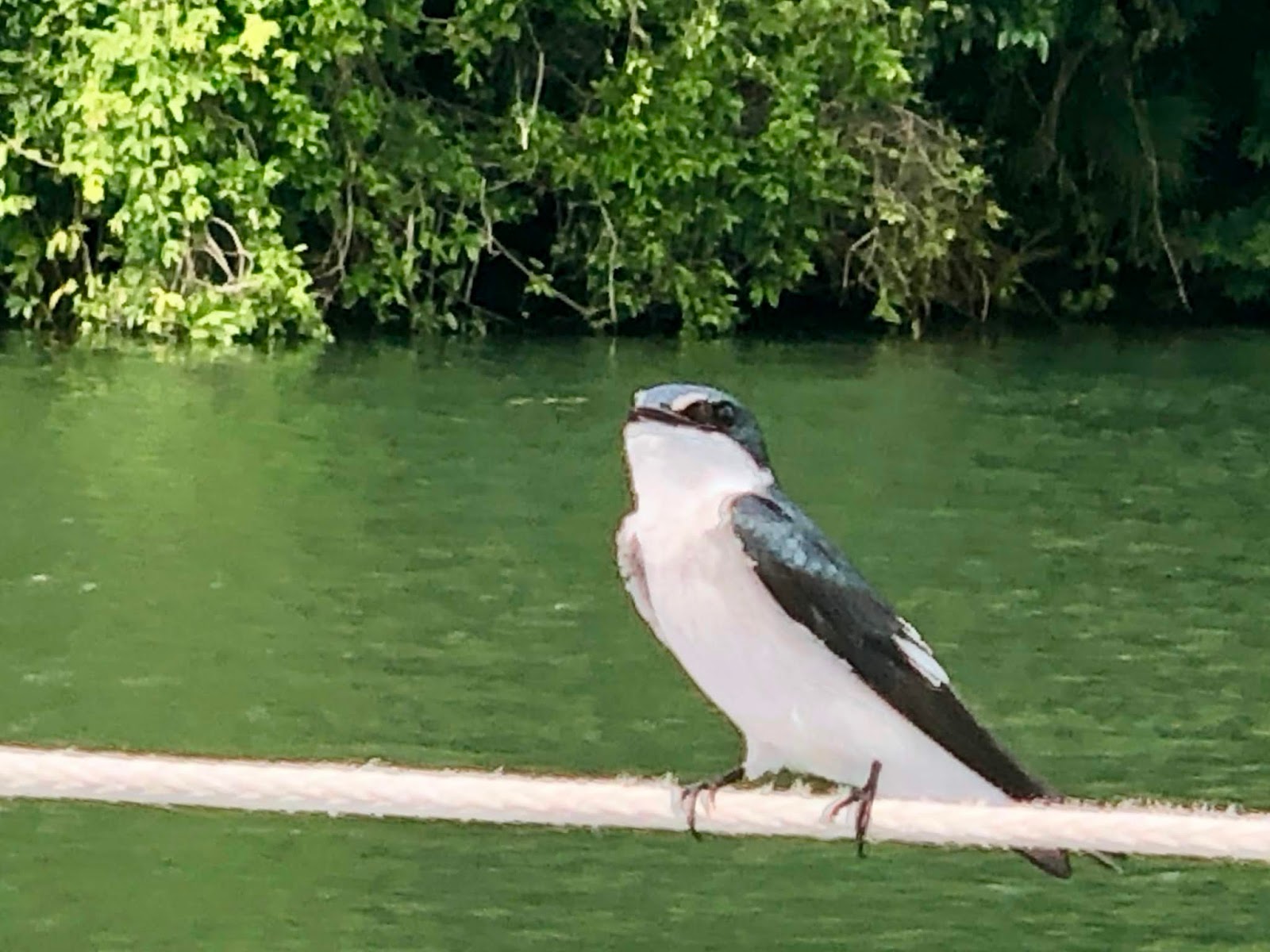
One of several tree swallows who came along for the ride
Geologically, the river basin is interesting. Harder, less easily eroded rock must stretch across the route of the river through the canyon, forcing the water to etch its way through its narrow, meandering path. Six miles upstream, the river opens up and becomes more shallow. Islands of various sizes create loopy streams, and the shores are lined with trees, slender reeds and sedges, and lily pads. This 2-mile wide area of the river, which seems like a large lake, is called the Gulfete, and sitting on stilts out over the water or hiding among the trees are a variety of dwellings from humble, small abodes of the local Garifuna families to finely crafted vacation homes and expat houses, often with large lanchas or sailboats on their docks. Fortunately, they are spaced far enough apart that they are picturesque rather than being eyesores.

Lakefront properties in the Gulfete
The Gulfete stretches from east to west, heading upstream, for 10 miles and then the river becomes more narrow, more like a river. And it becomes more populated. We started to see marinas on both the north and the south shores and ahead was one of the largest bridges in Central America, connecting the north shore town of Fronteras, commonly just referred to as Rio Dulce, and El Relleno. Constructed high enough to allow passage of tall masts into Lake Izabel upstream, the slope of the roadbed forces heavily loaded trucks to cross the bridge at lumbering speeds in low gear. 

We stopped in Texas Bay in the Gulfete that night in order to leave several sails for repair with a sail maker and rigger there (a guy formerly from Ohio). It started to rain shortly after we anchored, so we enjoyed the snowy egrets and comorants coming in to roost instead of taking down the mainsail.  Later, after the rain, we kayaked to a restaurant and afterwards, under a nearly full moon, paddled around the area.

The next day was dry and calm and perfect for taking down the main. We spent a couple of hours at the loft, leaving behind not only the main but the spinnaker, the staysail and mainsail cover, all of which are in need of minor but necessary repairs.

Since departing from San Andres, we had been in contact with our friends on S/V Mahi, Carla, Joe and Ethan Barrett, whom we met in Port Antonio, Jamaica (even though their house is quiet nears ours in California and both Joe and Peter worked at Intel in Folsom). Carla is one of the most sociable people I have ever met, and she is generous with her wealth of knowledge about everything here in Rio. They arrived here in the early summer and spent a couple of months at home, and they have now been back here for several weeks. 

After anchoring near their marina and cleaning up, we had dinner with them that evening at the restaurant there, which was lovely. Our first job in Río was to find a place to leave our boat for a couple of months. Carla and Joe seem to love Tijax, but we wanted to check out several options and recommendations. So the next morning, we set off in our lopsided dinghy with one leaking tube (but at least the engine is working reliably!). We visited Catamaran Island Marina, which we really liked. We dinghied past Monkey Bay Marina on the other side of the river; we had been told it had no space, but we would probably not have chosen it anyway because of the wakes from frequently passing lanchas. We then pulled into the dinghy dock at RAM Marine, a boatyard where another Sundeer is currently on the hard. Peter wanted to get a quote and consider getting the bottom painted. We also liked this facility but ultimately decided that we do not need to haul out right now, even though the prices are reasonable. We were beginning to understand why Río Dulce has become a mecca for yachties. Some people come here year after year for the hurricane season; others come for a hurricane season and never leave; many come for a few weeks to visit and end up staying for months. Right now the climate is pleasant, although it can still get skin-frying hot in the afternoons and I have been total the summer can be brutal, and, well, it’s the tropics, so there are bugs. But all the marinas are beautiful and even the boatyard was more attractive than most. The local people and the yachties are very friendly, and the boaters have formed a strong community. 

Anyway, we were getting hungry, and I texted Carla on WhatsApp about lunch suggestions. We decided to meet at a hotel/restaurant/marina where they had stayed on land for a few days while their boat was hauled out for engine repairs. Carla had mentioned that we might want to consider leaving our boat there. Boatique, which we finally chose as for our berthing, served delicious food for lunch. It is located on a creek off the river, secluded and protected and quiet (except for howler monkeys). After talking with the owners of this new facility, we decided that although it does not offer a social life like Catamaran Island, it works for us, particularly since we won’t be on the boat for two months. 

After lunch and docking discussions, we went back to Tijax Marina to visit with the owners of another Sundeer, S/V Tamarisk, David and Anna. The owners of the 20+ Sundeers throughout the world always like to connect whenever they are in the same port. They are busy working on their boat, but we had a nice time talking with them. Then, we looked for the Barretts around the marina. We had just about given up on finding them when we encountered Carla at reception, out of breath and telling the staff that another marina guest had called her in a panic about a close encounter with a pig and a large, unfriendly black dog on the path from the road to the docks. In the end, the friend was all right but shaken up.

We had planned to go into town for a few provisions, but it was getting near sunset and we had been out all day, so we went back to our boat and added provisioning to the to-do list for the next day. 

On Friday morning (November 15), we meant to start running errands by mid-morning, but we got busy with cleaning, organizing and taking down the genoa. One task led to another, and it was afternoon before we set off. We went to Mar Marine because someone who came by in the morning to get bottom paint we were giving away to re-paint the shark teeth on his bow told us we might be able to get our liquid propane tank re-filled there. Also, I wanted to donate some galley items to Pass It On, which is at that marina, give away some guide books and find a place to recycle. Pass It On was able to help us with all of that, but by then we were quite famished, so we decided to have lunch at Jade, the restaurant there, before going to town. The food was quite good but the portions were enormous, so the leftovers became today’s lunch. 

Our next stop was in town for groceries. Another couple (from Yorkshire) had just arrived at the dinghy dock of the popular restaurant/bar called Sundog when we did, and they showed us the produce vendors and the grocery store, which is owned by Walmart but does not resemble a Walmart in any way. The main street through town, unlike laid-back Livingston, bustles with pedestrian and vehicular traffic, including the large trucks using the bridge. The fronts of stores sit right along the street. There are no sidewalks, just a narrow berm, so pedestrians share space with a constant stream of trucks, cars and motorcycles. Narrow, shaded alleys--too narrow for vehicles-- shoot off from the main road, and they are crowded with merchandise hanging from awnings above baskets, buckets and boxes containing a variety of items, including knock-off clothes and toys and second-hand items. Perhaps when the sun is at its zenith, some light penetrates into these shadowed arcades, but I suspect they are always dim. I did not venture down these alleys, but I was very happy to be able to avoid haggling and to buy vegetables at an extremely reasonable price from a vendor who was helpful on the main street.

Finally, we made it to Tijax, where we had thought we would be in the morning. David had heard us on the cruisers’ net in the morning, inquiring about a dehumidifier, and had radioed to offer us his. By the time we arrived, he and Anna were wondering if we ever would. We had anticipated paying for the equipment, but it was a gift which we will pass on when we do not need it. 

Earlier in the day, I had heard from Carla that she was sick again. She had acquired two nasty parasites earlier in the year, beforing summer in California. She was misdiagnosed there despite telling the doctor she had been in the tropics and did not get proper care until they returned here earlier this fall. Finally, she had just started feeling better, but then, yesterday, other symptoms arose, and a visit to the doctor and quick turnaround lab work revealed a new parasite! Poor Carla! She swears she will only eat food she has prepared herself on her own boat until they leave Guatemala. We visited with the Barretts to see how she was faring before we left Tijax and went home with a full dinghy after another long day.

This morning, we brought the boat to Boatique and have settled in at the dock. The staff is doing my laundry now. I am not allowed to use bleach on the boat because it ruins the valves in the pumps, so I am delighted that they are able to add a little Clorox to my load of white sheets. 

Ducks in the creek by our boat
David and Anna are coming for drinks and to see our boat at 5 o'clock, unless deterred by the rain. (It is a rainforest!) Both Peter and David can talk endlessly about Dashew boats in particular and boats in general. I think Anna and I may go to the restaurant and discuss other aspects of life.


Saturday, November 9, 2019

Stuck in Útila by Weather

It’s now Saturday, Nov. 9, and there continues to be entirely too much rain for us in Útila. There has been torrential rain and a few squalls, and the anchorage has become very rocky. If we weren’t used to living on a boat, we might get seasick just being at anchor here.

We snorkeled on the afternoon of Thursday, Nov. 7, and it was great, but we have not had another opportunity because of the depressing overcast skies and rain falling in buckets. It is not hot, but we have had to use the air-conditioning just to get some of the ambient moisture out of the boat.

A friend of Peter’s brother Rob’s nextdoor neighbor in England has lived here for 25 years, and we got in touch with Tara and met her for frozen lemonade on Thursday and again for dinner last night at Chez Pancho, where she, a friend of hers and Peter enjoyed Argentinian steak and I had an omelet with yummy fresh mushrooms. 

There is one main street paralleling the waterfront in the town of Utila. It is lined with dive shops, hostels and a few restaurants as well as little stores selling random pieces of clothing and an assortment of toys and household goods, the clothes and other things looking like merchandise found in a thrift shop or a dollar store. I have no idea where the proprietors source there miscellaneous wares. The main grocery store, Bush’s, stocks a lot of American brands of packaged food, including ramen noodles and the type of food we would take camping, obviously catering to the many young people who come here from the States and other parts of the world to get certified in various levels of diving. They live in rooms let by local homeowners or in rather squalid looking apartment buildings. There are no cars although quite a few motorcycles and four-wheelers share the narrow paved streets with pedestrian traffic, weaving in and out around parked vehicles on whichever side of the road is free.

The expats whom we have met here came to dive and never left. It’s not a place I would choose, but I can see that the laid-back, slow pace of life and tight community of people would be appealing to some people. 

Peter and I hope to leave for Guatemala tomorrow. We got ready to take the dinghy in to shore during a brief respite in the rain, and then peals of thunder and flashes of lightning appeared before we could cast off, so we have not left the boat all day. It has been really boring and a bit miserable. We have our fingers crossed for a passage tomorrow.

Wednesday, November 6, 2019

Expats and Coral Reefs of Guanaja

On Halloween morning, we moved Mantra back to the lee side of Bonacca Cay (We had moved the previous afternoon to be away from the town.) so that we could clear in with the port captain, whom we just missed the previous afternoon. Another man greeted us on the dock and directed us where to tie up our dinghy and helped us out. He wanted to show us where to find everything, but we explained that we had already paid Mario too much the previous day for that service. Nevertheless, he followed us to the port captain’s office and waited outside for money, which we did not give him. Also at the dock, a young boy asked if we would pay him to watch our dinghy. I asked an adult nearby why he wasn’t in school and was told that he goes when he feels like it! Although there was absolutely no need to have the dinghy watched, particularly since we chained it to the dock, Peter agreed to give him a dollar when we returned in a couple of hours.


After our business at the port captain’s office, we went to the bar where Mario had told us the ex-pats gather on Thursdays. We were too late for lunch, which consisted of one choice, but we each had a beer and chatted with people from the US and Germany who have made Guanaja, Honduras their home. There are quite a few characters in the expat community of the island, but they were all very welcoming and invited us to visit them at their homes. 


We then went in search of lunch and found a cute little restaurant, Pat's Pizza. We decided to share a vegetarian pizza. The owner told us it would be ready in 30-35 minutes if we wanted to return, so we walked around some more. Along the windward shore of the cay, we were awed by Magnificent Frigatebirds in flight. (Magnificent is not used as an adjective; it’s part of the name. But, they are magnificent.) It must be mating season, because the males, which are all black, had bright red throat pouches which they can inflate to attract mates. Both genders have long, forked, scissor-like tails. The leading edge of their exceptionally long wings form a wide, obtuse angle.  The females also sport iridescent black feathers except for their breasts, which are white. Relative to their weight, Magnificent Frigatebirds have the largest wingspan of any bird. They are a joy to watch in flight.


Female Magnificent Frigatebird
When we returned to the small, comfortable and colorfully decorated restaurant, the pizza was not yet ready, so we waited. Then, a young female employee brought it to us, all wrapped up in foil and placed in a large plastic bag. We explained that we had hoped to eat it there. After some confusion, we learned that the restaurant was actually closed, although the door was open. They had stayed to make our pizza. We told them we had not realized that they were closed and got ready to pay and leave when an old woman, perhaps the mother of the owner, came out and insisted that we sit down to enjoy our pizza. She said that she would remain so that the young woman could go home for lunch. She was so gracious that we could not refuse her generous offer--besides, we were really hungry and the pizza smelled really good!


We bought some produce and a freshly baked loaf of bread and returned to the dock. The boy saw us coming and ran over to our dinghy; he couldn’t have seen it from where he was. Peter gave him the equivalent of a dollar plus some change in limperas, the national currency. Rather than cheerfully thanking us, he just pouted and said, “Another dollar?” Peter told him that if he did not go to school and study hard, he might end up on that dock for the rest of his life, trying to make enough money doing menial tasks. He didn’t seem to care.


Back on Mantra, we pulled up anchored and went back to El Bight, our previous location and enjoyed a quiet evening.


It was an organizing and inventory day on Friday, Nov. 1. I organized all the cleaning supplies that were under the bathroom sink and the sink in our bedroom and moved the ones that are for on deck cleaner to the aft lazarette. The previous owners had duplicates of many things.  For example, the varnished wood floor (or sole) of the interior is just not that big, so I cannot understand why there would be a need for four different types of floor cleaning liquids. There are also four different gallon containers of mold and mildew cleaner which I have not had to use since we bought the boat in March 2018. 


In the aft lazarette, which Peter and I worked on together, there are a number of solvents, several different kinds of metal polish, various brands and types of fiberglass cleaner and wax, brass cleaners, canvas cleaners and waterproofing agents and other maintenance substances. It will take us years to use all of them.


Early in the evening, after leftover pizza, we dinghied over to the palapa covered bar of Hans Pico, a German expat whom we met on Thursday. We were the only custumers, so we conversed with him about his life, his farming, his beer brewing and his wine making from tropical fruits.


On Saturday, Nov. 2, after a slow morning, we dinghied over to visit Jim and Cathy, US expats from the backwoods of Georgia who have lived on the island for over 25 years. He was an underwater demolition specialist and she was an herbalist. As we have gotten to know the various expats in Honduras,we have realized that there is a difference in character between them and the ones we met in Boca de Toros, Panamá. In Panamá, the expats seemed to be retired professional people who have left their countries for a tropical paradise where they can buy property relatively cheaply on their savings and have a less hectic lifestyle than in the States or elsewhere. On Guanaja, the expats all seem to be non-conformists who chose to settle here to live off the land, grow marijuana as well as other crops, and have little interference from any government. If we were going to become expats, one of the motivating factors for us would be escape from the pro-gun culture in the States. The expats in Guanaja are gun loving folks who believe that their rights to own and use guns was too restricted in the US!


After our visit with Jim and Cathy, we went to the restaurant up on the hill above El Bight called Mi Casa Too. Each of the risers of the 167 steps are painted in bright colors as are various signposts along the way, so the climb is enjoyable. We were attending a fundraising event for a local environmental non-profit. We joined some other expats we had met on Bonacca Cay on Thursday. As part of the festivities, there was a game of ocean trivia, with categories such as coral, mangroves, global warming and plastic. Of the five teams, ours won easily; I knew the answers to all the questions! We had dinner and drinks while we were there and stayed until a later afternoon shower, which produced a wonderful percussion on the rooftop, ceased and we made our way back to our boat in the night.


Peter ascending the stairs to Mi Casa Too
The skies were clear as the morning began on the morning of Sunday, Nov. 3, but by the time we were debating what to do, torrential rain began and Peter was able to fill all of our bottles for drinking water and put about 200 gallons in the tanks. After lunch, we pulled up anchor just as another sailboat was coming into the anchorage. We traveled for about a half hour to the north side of Josh’s Cay, part of a long reef that borders the southeast end of the island. Another sailboat was there, but it was pulling up anchor as we circled to find a spot, so we had the place to ourselves. (This seems to be our modus operandi.)


We put the anchor, the rope ladder and snorkeling gear in the dinghy and motored over to the gently breaking waves of the fringe reef. On the inside, there was grass and sand and a few coral patches, but we found a shallow way through the breakers, following an ocean triggerfish,and came across an entirely different marine environment where coral canyons ten to twenty feet deep formed narrow rows with white sandy bottoms. Hundreds of blue tangs and doctorfish greeted us, and we also saw gorgeous adult and juvenile French angelfish among the other types of angelfish, parrotfish, wrasses, snappers and other tropical fish. Peter discovered an octopus and I spotted a couple of small toadfish hiding under ledges. There was an abundance of elkhorn coral. All of the coral seemed healthy except for patches of fire coral, which were bleached to pure white, their algae killed by something which did not seem to affect the other species.


We stopped on Josh’s Cay on the way back to Mantra to check out the resort called Grahm’s Place. It is a lovely, well-maintained resort with colorful bungalows and an attractive restaurant and bar stretched along a sandy beach. Hammocks hang from trees and three green parrots and one red and blue macaw squawk from their cage, which I think is much too small for them. 


On Monday, Nov. 4, in the morning, Peter worked yet again on the small dinghy motor. I believe that he has spent more time working on that engine than we have actually used it. After a couple of hours, he was quite optimistic that he had it running well. He took it for a test run and then we put our snorkeling gear in to go to another part of the fringe reef. The engine fired right up, and then it died suddenly only 100 feet from the boat. After another ten minutes or so of fiddling, Peter had it running again, and we made it to the reef. We had to duck walk backward over the highest part to get to the outside, where the coral formations dropped off into the depths. The best thing we saw was a nine foot nurse shark quietly resting on the sandy bottom between reef ridges. It was, we think, the largest one we have ever seen. There were also blue and French angelfish, both adults and juveniles, yellowtail snappers and Rock Beauties as well as one unwanted lionfish. 


In the late afternoon, we dinghied over to the main island to visit expats from Michigan, Don and Annette and their daughter Asalen. Don worked in construction before retiring, and he is obviously a stickler for quality and detail. Their property is simply gorgeous, although just three years ago it was jungle and muddy swamp. They have a long dock which meets the land on a large sandy beach. Inland from this is their garden with fruit trees and vegetables, bordered by blossoming tropical shrubs. Their home is comprised of three main buildings connected by covered walkways and rising up the hillside. The lowest is the living area and the middle is an entertainment area with its own full kitchen and a large solid mahogany table produced by local craftspeople, as was all of their rattan furniture. Their bedrooms, with an expansive verandah encircling the building, are in the highest building with a panoramic view of the lower property, the sea and the cays south of the island. The predominant color is turquoise, inside and out, and it is an extremely tranquil and welcoming place. They have made themselves a tropical paradise.


After visiting with them, we dinghied over to Graham’s Place. It is low season in the Bay Islands, so there was only one family having dinner besides us. We were so impressed with this resort. Everything looks like a fresh coat of bright paint was just expertly applied last week. The sand is freshly raked. Plus, the service was excellent, menu was extensive and the food we ordered was delicious and a nice change from our cuisine on the boat.


The next morning, Tuesday, Nov. 5, we pulled up anchor and sailed and motored around the eastern end of the island to Michael's Rock. This anchorage had been recommended for its excellent snorkeling. A wide reef extends along the entire north shore of Guanaja; weeks could be spent here without snorkeling in the same place twice. The part that we swam over was without a doubt the most spectacular shallow reef we have seen, with a great variety of coral, sponges, algae, gorgonians and fish. I even saw a small turtle (not sure if it was a hawksbill or a green turtle). Among the mutlitude of jacks, grunts, angelfish, butterflyfish, snappers, squirrelfish, parrotfish, wrasses, surgeonfish, damselfish and other tropical fish, we saw a large queen angelfish; a long trumpetfish; little iridescent blue chromis that seem to glow from inside; an abundance of barred, blue and indigo hamlets; a red hind (a type of grouper) with its tan speckled body and black margined tail; a spotted burrfish; a balloonfish; and a smooth trunkfish. My hands and feet were like prunes by the time I returned to the boat. 


Right before sunset, we pulled up anchor to head off to the island of Útila on an overnight sail. We put up the mainsail inside the protected reef while heading into the wind and then, while, turning back on course, accidently and suddenly ran into a large chunk of reef, making a crunching, grating sound. “Reverse, reverse!” I yelled and we backed off. That was a first, and we don’t want to do that again!


Sailing and motoring overnight, only encountering one brief squall and no pirates, we arrived mid-morning today, Nov. 6--greeted by dolphins, including a baby--in the bay off the only town on the small island of Útila. The sun was intense by the time we dropped anchor, making even the teak sole of the cockpit fiery on our feet. Peter is now sleeping since he was awake more than I was during the night. When he awakes, we will explore the town and then figure out where to snorkle. Reefs are everywhere! This is our last stop before leaving the boat in Rio Dulce, Gautemala, so it’s the last opportunity for snorkeling this year.

Dophins off the bow