Tuesday, March 3, 2020

Adios, Guatemala!

Today, we successfully escaped Guatemala, clearing out before noon. We had a lovely time motoring through the gorge of the Río Dulce under sunny blue skies. There seemed as if there were many more birds than when we went upstream in November. Literally, there were thousands of egrets, cormorants and brown pelicans and hundreds of frigate birds. The frigate birds soared overhead. The egrets waded along the edges of the river and sat on top branches of lush green trees rising up the canyon walls. Brown pelicans glided by, only occasionally flapping their wings, in small groups just above the surface of the water. Seeing fish in the water, they would land with a spectacular splash and bob up to gulp down their catch. Other pelicans roosted on branches together, sometimes weighing them down until it seemed that the limbs might break. Little white breasted swallows with iridescent blue-black backs and wings flew acrobatically around the boat and landed on the lifelines, where they sat stock still except for their flat-topped heads, which they moved side to side continuously, seemingly curious at the world moving by as they perched quietly. I could have dropped anchor and watched the birds for hours, except the open sea was waiting for me and I was almost there!

Tree swallows along for the ride
After stopping briefly in the colorful, lively town of Livingston to get our passports stamped and obtain our zarpe (official entrance and exit paper) for the boat, we took a water taxi back to Mantra and hauled up our anchor. Hector arrived in his powerboat Wally to accompany us out of the mouth of the river, attaching a strong line to our spinnaker halyard in order to pull us over when the water became too shallow. When we saw that we were at zero meters under the keel and felt our boat ploughing into the silt and slowing down, Hector hauled on the line and we heeled over about 20 degrees, freeing the prop to surge ahead. It was an interesting experience hearing the starboard side of the hull grinding softly against sand and mud.

Once free of the shallows and untethered from Hector's boat, we bid him "Hasta proxima!" and sailed into Honduras Bay and the Caribbean. Dolphins came to welcome us back. We tested out the sails, enjoying 20 minutes of motionless propulsion, but we were headed into wind and had to turn on the engine again. Now we are peacefully anchored just south of Punta de Manabique in Honduras, and we will clear into Belize (finally!) early tomorrow morning.

Open sea!
Sunset from our anchorage

Monday, March 2, 2020

The Sails Are Back!

On Saturday, we were ready to leave the dock, but we were stuck in the mud! Another sailor brought over his dinghy and took the spinnaker halyard to the opposite shore of the creek and tied it to a tree. The line slipped up the trunk of the first tree just as we were probably heeled over enough, and, boing, our boat righted herself in a flash. We chose a bigger tree with a larger trunk and put a lot of wraps around it. This time, it held, and the prop was out of the mud enough to move forward into the narrow channel of the creek. Then the dinghy pulled us back into deeper water, and we were off!

We went to MAR Marine to fill our tanks with fuel and potable water and to purchase a couple of cans of Coca-Cola sin azúcar, and we were ready. Well, maybe. The dripless shaft seal is now dripping at high revs, which it was not doing before. It's always something! We anchored near town and it felt good to be rocked by moving water again.

On Sunday morning, we met David and Anna for a pancake breakfast at Tijax Jungle Lodge and Marina, took a look at their almost finished hard dodger which they have modeled after ours and bid farewell. Back onboard Mantra, Peter decided he needed to tighten the alternator belts before we pulled up anchor, so it was a couple of hours before we actually started downstream.

On the way down the river, we tested the engine at ever increasing revs, and Peter discovered that the seal starts spraying water over 2200. He is worried about this happening when we are in salt water. He has crimped the lead now, his first possible solution. I wouldn't want him not to have potential catastrophic malfunctions to ponder in his spare time!

By mid-afternoon, we were anchored in Texan Bay on the downstream end of El Golfete. Peter dove under the boat again to clean something down there that may be effecting the dripless seal. (I just nod my head as if I understand when he explains.) He came back up convinced a clog was not the problem.

We are quite near two islands absolutely filled with hundreds of nesting cormorants and snowy egrets. The rest of the afternoon, they flew singly and in groups, swooping low over the water, landing effortlessly on target on their perches. There is a cacophony of sound, and we were close enough for the pungent odor of their profuse droppings to waft across the deck and down below. I love being close to nature! Near sunset, we took the dinghy over to the two islands to get a closer look while trying not to excite the fear of the parents. We couldn't see any chicks; the birds are still sitting on the nests.

Cormorants roosting for the night with their nests
Cormorants and snowy egrets
As the birds quieted down for the night, their sound was replaced by the hollow drumming of toads and frogs, a lullaby for sleeping.

This morning we pulled up anchor at 7:30 and motored over to Rigger Tom's to pick up our sails. We were accompanied by blue, black and white sparrows and vivid yellow warblers who flew around the standing rigging and landed on the lines, spreaders and radar, making the short trip a delight. I was assuming that we would just collect the sails and then have to spend hours ourselves rigging the main. However, Tom and his crew just took on the job quickly and are doing in an hour or so what would have taken Peter and me most of the day. My presence would be superfluous, so I am writing this blog.

Because the rigging is going so quickly, we may be able to clear out of Guatemala in Livingston today. (I have my fingers crossed!)


Friday, February 28, 2020

Hooray! The New Engine Exhaust Pipe is Installed!

Two weeks after ordering (as predicted), our new piece of engine exhaust pipe arrived, and Peter has successfully installed it. We will be able to cast off the dock tomorrow. On Monday morning, we will pick up our sails and have the rigging inspected. With any luck, we will be in the waters of Belize sometime on Tuesday!

One advantage of spending a month in a small country and staying in the same place for weeks with not much to do is that there is time to converse with local people and expats, to learn more than the usual tourist does, and to reflect on the lives of the people for whom this place is home. Guatemala is the most densely populated of all the Central American countries and has a larger percentage of native (Maya) people as part of that population than any other nation in the region. There is a wide divide between the rich and the rest, and poverty, lack of education, employment opportunities and malnutrition are major problems. 

A couple of days ago, I read about George Clooney being appalled to learn that children are working on the coffee farms in Guatemala which are a source of beans for Nespresso, the brand with which he is associated through advertising to the public and through his membership on its Sustainability Advisory Board. Reading or hearing about this through the media, a conscientious person in a first-world country might automatically condemn this practice and hold the company responsible for child exploitation. However, being here and having traveled in other third world countries, and having talked with people here on the ground about the livelihood of the local people, I think that it is unlikely that Nespresso or its farmers are actively recruiting children for the workforce. This does not mean that there are not children working on the farms; there probably are. However, these children have been encouraged by their families to seek work to get money for the most basic necessities such as food, to stave off starvation, or they have taken it upon themselves to work. It must also be kept in mind that this is an agrarian culture in which children are in the fields with their parents and grandparents from a young age and begin helping when they are able. For the local people, there is nothing unusual or wrong with children doing manual labor. We see it all the time. We have been served food by pre-teens in family-run restaurants. Just today, we saw four barefoot teenagers working, manually driving pilings for a new dock.

Four teenager manually driving pilings
There simply is not enough of many things in Guatemala:  food, clean drinking water, education and employment. The population, which is growing faster than any other in Central America, cannot be sustained by the resources available. Recent droughts have caused crop losses and localized famines. Currently, 60% of the population is living in poverty and at least half of the children, who comprise about 50% of the populaiton, suffer from some degree of malnutrition. 

Given this situation, it is not surprising that teenagers, if they can, are working to survive. And what else would they do with their time? The government provides free education to children only through sixth grade. Beyond that, there are private schools in some areas, and those families who can scrape together the tuition usually can only do so for one child, almost always the oldest boy. Therefore, most children pass the age of 12 are not in school. What do they do? They look for employment; they marry and start having children at a young age. At around the time of puberty, as has been normal in human culture for millinnea, they become part of adult society. 

If first-world cultures find this appalling, if they believe that childhood should extend through the late teens and that youth should be afforded education and leisure, then they need to do more to assist in making education free and available to teenagers in places such as Guatemala. Child labor will not be eradicated (if, indeed, that is a necessary objective) by company policies forbidding the hiring of teenagers or even those younger. One practical tactic is for Nespresso and other international corporations to supply facilities, teachers, books and other materials to allow children to be educated past the sixth grade in the communities and areas where they are hiring or subcontracting labor. Another way to deter child labor is ensuring adequate nutrition in the population through directly supplying food or promoting sustainable agriculture that is adaptable to a changing climate.

Until recently, children in places such as Guatemala, probably had no idea that free public education through 12th grade is a reality for most children in first world countries, so they did not realize what they were missing. Cell service and the Internet are rapidly changing the local people's awareness. Yet, while I have observed poverty, I have not noticed people doing any type of work being disgruntled. The four young men we saw doing pile driving earlier today were joking and laughing as they worked with no shoes, no helmets and no harnesses high above the water with an extremely heavy tool. Yes, it might be nice if life here offered them more but, on the other hand, they are not expecting more and as long as at least their basic needs are met, they seem to be happy.

Wednesday, February 26, 2020

20 Days in Río Dulce, But Who's Counting? We All Know Who Is!

Since the last post, life has crawled on, with Peter diligently working and watching the stock market and with me languishing in tropical torpor. There have been more monkeys to watch and more birds to see (including the lovely Montezuma oropendola and striking green heron). Butterflies flutter in the foliage near the ground, including many types of heliconius such as the bold red postman (Heliconius erato). Its ebony wings have a creamy white stripe across the top of each hindwing; each forewing is brightly highlighted with a wide crimson bar paralleling the black body, halfway between the tip  and the base of the wing. The loud, hollow rapping sound of the toads has returned in the early part of the night. There are manatees in the river, but we had no luck finding any on a dinghy expedition on Sunday.

Unable to dislodge the hydraulic autopilot system, even with the aid of a blowtorch and a pulley puller borrowed from a fellow cruiser, Peter used Plan B and by-passed one of the two pumps so that we have one system that works. After shopping around the limited supply of outboard motors, Peter finally settled on a 15HP Yamaha Enduro, which we purchased a few days ago. It will now be possible for me to venture out with the dinghy on my own. The motor starts reliably and easily so even a mechanically unskilled person (me!) can manage. Also, with the additional horsepower, our trips into town for errands are now much shorter in duration.

We have made a number of frustrating and fruitless visits to marine supply stores and boatyards in search of pipes or stainless steel elbows or any part that might be used to jerryrig an engine exhaust hose and have finally resigned ourselves to waiting for the part ordered from the US to arrive. It is supposed to be here in two days, meaning we should leave (fingers crossed) be able to leave the last day of February! We still have to stop for a couple of days downstream to pick up repaired sails and have the rigging checked and then at the mouth of the river in Livingston to clear out of Guatemala, but with luck we may be on the reefs of Belize by the middle of next week.

The monotony was broken yesterday by a trip to some lovely natural wonders with four other travelers--young guests at the hotel--and an expat guide, Bruce. Our first stop was Finca Paraíso's Cascada Caliente. We hiked along a well-maintained trail to reach a place where steaming water from a hot springs at the top of a cliff streamed down across roots and rocks to fall into a pool in a clear, cool stream through the forest. Stalactites slowly grow along the hanging roots and rock faces. Behind the falling water is a small cave reached by diving under a row of short stalactites like scraggly, rotten, pointed teeth in the mouth of a large monster to a greenish interior. A guide brought us clay mud which we rubbed all over our bodies for exfoliation, letting it dry in the sun before washing it off. Little fish pecked at our feet and ankles if we stood still, biting off tiny dead pieces of epidermis. The seven of us stayed and enjoyed this little piece of paradise until other people started to arrive.

Finca Paraíso's Cascada Caliente
Sherri and Peter
Peter and the others in our small group
Looking downstream from the hot waterfall
Rainbow in the droplets of the cascade
Hibiscus in bloom
Half meter wide spider web
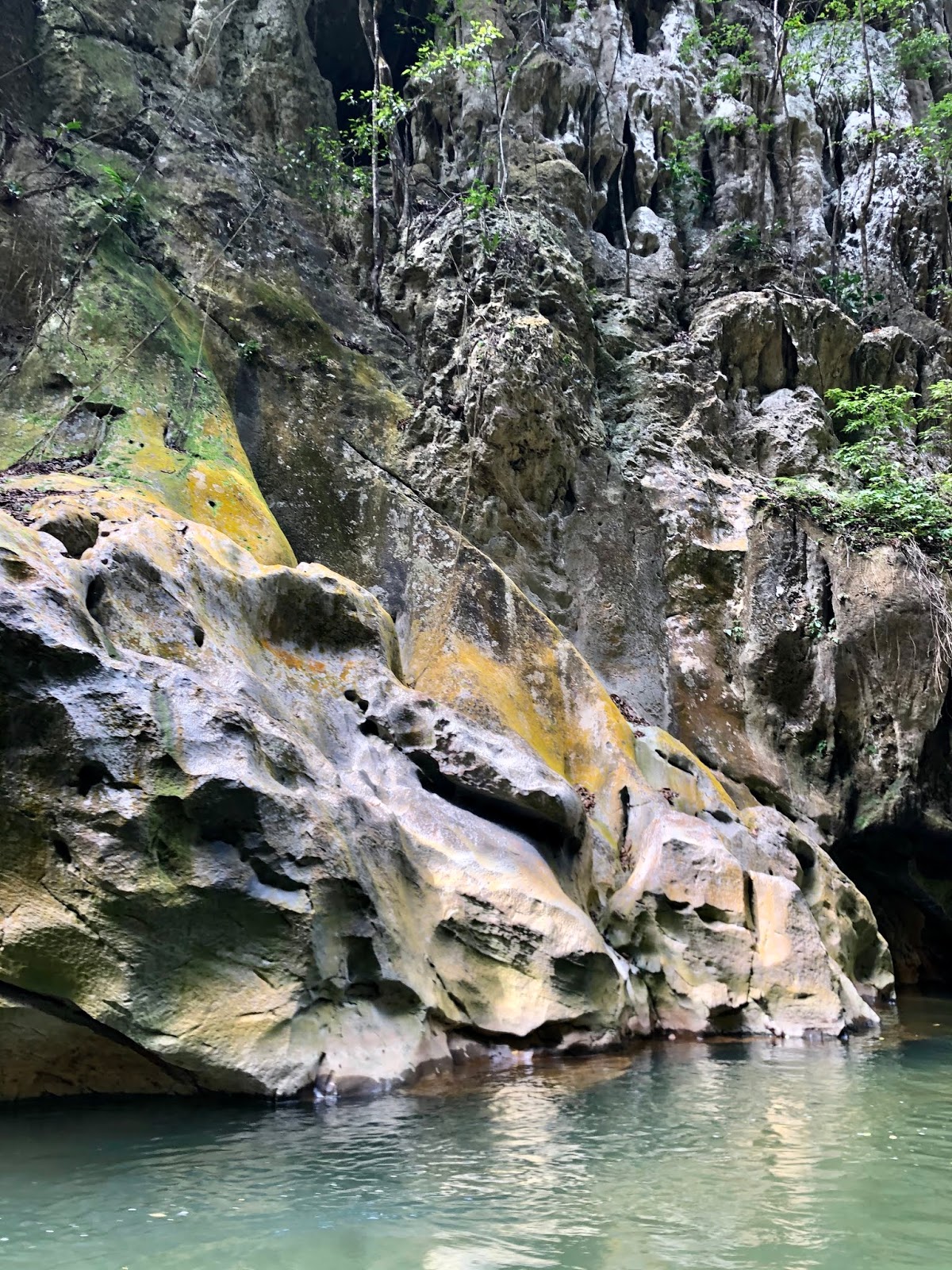
Our next stop was the Cañon del Boquerón, where we loaded ourselves into a large cayuko and were paddled upstream into the narrow canyon from the open plane bordering Lake Izabal, where the river empties about a kilometer downstream. The vertical limestone faces soared above us, up to 600 feet high. Vegetation secures itself in any way it can. Roots of trees worm their way into crevices in the rock. Ciebas and other tropical trees perch precariously on stony protuberances above, dangling their their roots hundreds of feet toward the flowing clear water at the bottom of the canyon. Ferns, bromeliads, orchids and other epiphytes attach themselves to the roots, to the rocks, to the crooks of tree branches, creating a much greater abundance of foliage than the trees themselves. Butterflies and hummingbirds flit among the plants, and ghostlike flowers passed their prime floated down from above, plopping on the surface of the water in quiet whispers. In some places, the roots are the base for slender calcium deposits formed by constantly dripping water, and the rock faces sometimes have stalactites and drapery. Geological evidence of uplifting and sedimentary layering and inclusions are abundant.

Cañon del Boquerón
Cañon del Boquerón
Stalactites form on the canyon wall
Stalactites dripping from the rock and roots
Algae color the rock
Balanced rock from upstream
Balanced rock from downstream
When we reached a place where the boat could go no farther without portaging, we climbed out and walked up the river, over rocks and coarse sandy patches, where we could. We swam against the current, eddy hopping when we were able, until we reached a place where a large rock with large trees growing on top balances on the rocks below, almost suspended in space between the canyon walls. This is where our guide Bruce had sent us, but our curiosity led us farther upstream to a small cascade and steps leading up to a path that, had we followed it to its end, would have led us to a mountain voyage and a put-in spot for intrepid kayakers in the wet season. But Bruce and lunch on the lakefront were waiting for us.

Our driver, Marie Cruz, picked us up in her big gray double cab truck after our trip into Cañon del Boquerón and took us to a lovely restaurant on the shores of Lake Izabal, the largest lake in Guatemala. Marie Cruz is one of the owners of Finca Paraíso along with her extensive, multi-generational family, who has owned the ranch for centuries. With fantastic views, cold beers in iced mugs, delicious food for both carnivores and vegetarians and pleasant conversation, lunch was idyllic.

Lunch at Finca Paraíso
From this wide-open space with its fresh air and well-maintained facilities we went back to the town of Fronteras (usually just called Río Dulce). Splitting up, we set out to get funds from ATMs, wine at the supermaket, and vegetables from the vendors along the street, who are packed into close quarters on the main street as well as gritty alleys. One of our group, a young Swiss woman, was looking for souvenirs, particularly textiles, but, despite the fact that the town attracts thousands of cruisers and adventurers with backpacks, none are available.

After drinks at the usual gathering place, Sundog's, we came back to Boatique. A dip in the pool was just what was needed after the hot and humid town.

Monday, February 17, 2020

It's a Jungle Out Here

So, here we remain, waiting, waiting, waiting. Yesterday, before sunset, Peter and I paddled a cayuko, a traditional dugout canoe through the jungle waterways. It is neither as easy to maneuver nor as comfortable as our kayak, but it was a peaceful experience moving through the water quietly looking at birds and turtles. We spotted one bird we haven't encountered before, a limpkin. This large, speckled wading bird was shuffling through the reeds along the edge of the creek, too well concealed for any photos.

Paddling in a cayuko
Today and yesterday, while hanging out in the pool area, we had better views of the golden mantled howler monkeys. They have black faces and thick dark brown, almost black hair, accented by longer, lighter, cinammon-colored guard hairs running down both sides of their bodies. Their bodies are about two to three feet in length with tails at least that long but sometimes much longer. The tails can support their full body weight, although generally only juveniles use their tails exclusively. Adults usually use at least one other appendage when moving among the branches of the trees. It is quite entertaining to watch them latch on to a branch with their tails and then leap to another one, seeming to free-fall noisily through the leaves. Of all the New World monkeys, howlers are the largest and are the only ones classified as folivores. We watched them carefully select leaves from the top of the canopy. In some cases, they broke off a twig or small branch and consumed the leaves and then casually tossed the wood to the ground. They also eat fruit, nuts and flowers, but we have not yet observed this.

Scowling howler
Upside down howler
Howler climbing down a branch
Meanwhile, as the monkeys enjoy a life of ease and pleasure, it seems, in the jungle, Peter continues to be challenged by the boat. Yesterday, he discovered oil in the engine room bilge and traced it to the  hydraulic pumps which power the auto pilot. We have two, and only one seems to be in need of repair, but they share a lubrication system, so either the broken one must be fixed by a professional or Peter has to reconfigure the system to leave it out of the loop. Right now, he is literally manually struggling to get the bad pump free from its mounting.

I did some minor work on the hull today, but otherwise I have been quite useless and unoccupied. Tomorrow will most likely be the same.


Saturday, February 15, 2020

Stuck in Río Dulce

Although I am ready to cruise in the western Caribbean and enjoy the stellar reefs of Belize, our boat is not. Peter returned from running errands yesterday, Valentine's Day, without candy for me and with very bad news. The engine exhaust hose which he had thought would be easy to obtain in Río Dulce is not available anywhere, and he has had to order it from the States. The estimate is that it will take two weeks to get here. This is extremely frustrating for me, for while Peter will have no trouble amusing himself and keeping busy tinkering on the boat, I am looking forward to two weeks of boredom. Although it is quite pleasant where we are docked at Boatique on a back creek of the river, there is really nothing to do but enjoy the jungle scenery and swim in the pool. I can't even go for walks because we are surrounded by water; I can kayak, but that only takes up a small part of the day. I can and will study Spanish more and read books, but these sedentary activities become boring after a while.

While we brought back from the States many items we needed for the boat (an extra 100 pounds of luggage), Peter did not purchase and return with a piece of flexible exhaust pipe even though he knew we absolutely had to have it because he had heard that there was a shop in Río that sold pipe and tubing , and there is a small West Marine here also. When we went to town together three days ago, we searched out the pipe shop. When inquired about what we needed, the man behind the counter pointed to a small heap of rubber hoses of various lengths and diameters in a dusty pile on the concrete floor by the street. There was nothing we could use; the slim inventory consisted of rubber tubing for big truck engines, not suitable for marine use and not flexible. The next day, Peter acquired a piece of tubing at West Marine, but when he tried to install it, he found it would not bend to fit in the space. Of course, he had to take out the old exhaust pipe first, and it cannot be re-installed. It is in even worse shape than he expected. So there is no way we can move the boat, because we cannot maneuver out of here under sail!

Over a day and a half, while Peter was out running errands, I worked on a tedious job, emptying out various containers of spare hardware from the engine room and sorting by type, size and other characteristics screws, nuts, bolts, washers, cotter pins, hinges and other items that have accumulated for more than 25 years on the boat and been stored in a haphazard manner. Now I have no table in the saloon, and it is anyone's guess how long it will be until Peter has decided how he wants to store them. I thought of my son Matthew, who, based on the expertise and qualifications he acquired through AP Psychology in high school, has diagosed me as suffering from OCD. This is certainly the perfect task for it!

My accomplishment! 
So, while I am ranting, I would also like to discuss restaurants and vegetarianism. Peter really wanted to go to a nearby restaurant for Valentine's Day, joining another couple we had just met. We ate at Dreamcatchers a few nights ago, and I was not that impressed but he was, so I agreed to go. It had been announced on the morning cruisers' net that the restaurant was taking reservations and would be offering three entree selections, including a vegetarian option. When we arrived, we found the options were dead cow, dead tuna and dead shrimp (my description, not their fancy ones). The option I, as a vegetarian, had was for them to leave the shrimp out of the pasta dish. I felt it was misleading to say that a vegetarian dish would be available. We assumed that the chef would be taking time to create a recipe, procure ingredients and prepare something distinctly and deliciously vegetarian. I am sorry, but removing ingredients and charging the same price for less food (and the protein is the most expensive ingredient) is not in any way catering to vegetarians. It merely exhibits disrepect and disdain for vegetarians. And, just to make the experience more wonderful last night, a black bug appeared and then burrowed into my food when the plate was presented!

At least I was briefly delighted yesterday watching golden mantled howler monkeys cavorting in the branches of the trees around here.

Blurry photo of monkey. They would not pose!


Thursday, February 13, 2020

Río Dulce

Life along the river is laid-back, at least for me. Peter is hard at work a lot of the time. It appears that finally he has been successful in getting the generator to run reliable, after replacing filters and pumps, checking pressure, finding leaks and doing various other tests and repairs. He is also replacing old lights and fans and generally working his way through the to-do list that never ends. At least at this point, it is getting shorter rather than longer. I have done some minor jobs, but I simply do not have his expertise for most of the jobs that need done on a boat. So, I cook him meals, make tea and, at the end of his workday, hand him a beer.  

I find the temperature and relatively low humidity (for a jungle setting) pleasant, and it is only sweating hot if I am working in the direct sunlight, as I was this morning. Fortunately, the pool is wonderfully refreshing. It overlooks shoulder-height, dense green foliage, with purple and white flowers, and a few spaced trees beyond which there is an open marshy meadow. In the daytime, butterflies abound. We especially like to go to the pool at sunset. In the gloam, thousands of fireflies flicker, yellow flashes in the twilight, in the near foliage and out over the meadow, with some occasionally spiralling up the trunks of the trees. This draws our eyes upward, and each time we look up, more stars have appeared in the black sky overhead as darkness deepens. The insects make background music in the otherwise quiet night. Occasionally, in the day as well as the night, howler monkeys bark and growl and moan, communicating with each other, claiming their territory. 

The first day we were back on the boat (last Friday), as it became dark, we noticed loud, croaking noises reverberating all around us. We went out toad hunting and found many. Watching first one then another carefully and patiently, we were able to see the mud gray toads expand their throats into bulging white sacs and vocalize. We happened to see one toad jump on the back of another, as if to mate. The toad underneath hopped one small leap away, followed by the first toad hopping back on top. Leap-toad! This repeated itself several times until the pursued toad jumped farther away and escaped. Later research revealed that sometimes the toads seem to be confused about gender and a male will hop onto another male; I believe this is what we observed.

I noticed that we did not hear or see the toads for the next couple nights, which aroused my curiosity. The Internet solved the mystery. At least some frogs and toads seem to align their reproductive cycle with the lunar cycle, gathering in one place at the full moon and mating on that one night.

Yesterday, Peter and I took the dinghy to town for errands. At our first stop, we encountered David and Anna from our sister-ship, Tamarisk, and we decided to have lunch together at one of the cruisers' favorite hang-outs, Sundog's, which specializes in pizza. We always enjoy the repartee with them. Aftewards, Peter and I set off to look for exhaust hose and a new (or used) dinghy motor to replace our larger one, which is beyond repair. This took us along the main road, where everyone walks on the narrow asphalt berm right beside the two lanes of cargo trucks, motorcycles, tuk-tuks and a few cars. With wheels turning within a foot of our bodies, we breathed in the exhaust, which is much dirtier than in the US, Europe and other places where health and environmental restrictions reduce the pollution. This was all we had seen of the town on our last visit, but our search for parts and an engine took us off this main road, where traffic was not nearly as intense and the streets were more pleasant, even though the buildings come within a foot or two of the road and the sidewalks are intermittent. At least there are no big trucks. Comidors, small storefront restaurants serving a limited menu of local food, are interspersed with tiendas, little stores that are crammed full of goods. Some are organized and tidy while others look almost like junk yards. It is often surprising how much can be found in these shops. I think of how shocking it must be for people from towns such as this to go into a metropolis such as Guatemala City and find modern shopping malls, where goods are arranged by size and color and brand and the aisles are wide and the lighting is good. Since we left here in November, a modern supermarket and a hardware store, side by side in the same large building, have opened. Since we desperately needed provisions, this is most welcome. However, the effect, we are sure, may be the same as a Walmart being opened in or near a town or small city; ultimately, the small shops are forced to close because people prefer convenience and low prices. Here, I am still buying our produce at the tiendas because it is not packaged; it is fresh from the fields, inexpensive and of good quality.

Baby chicks for sale in one store--not a pet store. These birds are going to be a source of food.
After our errands were completed, we headed back to our boat, detouring slightly to get close to the aptly named Bird Island. As the sun was getting low in the western sky, pelicans, herons, cormorants, egrets and other birds were arriving for the night, circling and landing in the reeds and the trees, white, brown and black against the verdant green. We also popped over to a sailing vessel at anchor, Mistral.  We had chatted with them earlier in the day by radio about playing cards and we just wanted to say hello personally. It turns out, they are from Ocean Pines, Maryland, just across the bay from where the annual Rodgers family beach vacation takes place every summer. We made plans to join them for dinner at a nearby restaurant for Valentine's Day (which I had forgotten about).

Birds flying in to roost
Comorants
Egrets and pelicans
After I worked this morning putting protective tape over the caulked edges of the windows in the hard dodger, I was tired and sweaty. The pool beckoned and I responded to its call. One young man was on the pool deck, a backpacker from Helsinki, and we had a nice chat. We really enjoy our brief encounters with so many people from around the world. Yesterday, it was a couple with a 7-year-old from Corsica. When I returned to the boat after my swim, I found a guest onboard, a beautiful green heron. It was sitting perfectly for a profile shot, showing off its long, narrow beak; the cape around its neck, maroon or rust or chestnut (depending on how the light was hitting it); cream-colored streaks along it neck, breast and sides (indicating it was an immature bird); and long yellowish legs and feet, with which it perched on the railing. "Kyowk, kyowk!" It announced its return a half hour later, where I found it sitting on top the wheel.

Green heron
Our plan is to start moving some time next week. I will probably have to convince Peter that he has accomplished enough. I am enjoying our time here, but after another week, I think I will be ready for the tropical reefs of Belize.